“Hasn’t your wife told you yet?”
The doctor’s question settled over the consultation room like dust after an explosion.
Martin turned toward me slowly.
For the first time since I had met him, his face held no prepared expression.
No polished smile.
No controlled impatience.
No performance designed for the person watching him.
Only confusion.
“What is he talking about?” he asked.
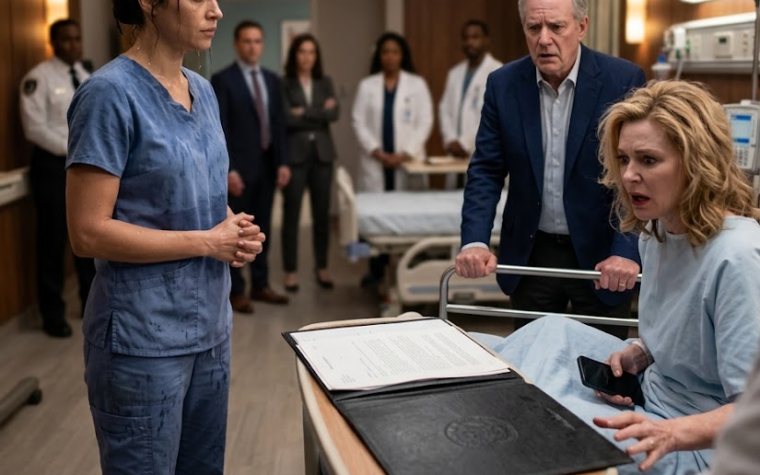
I placed the black folder on the desk between us.
The clasp made a soft metallic click when I opened it.
Martin’s eyes dropped to the first page.
His name appeared at the top beside the date from five years earlier.
Below it were the clinic’s seal, the laboratory number and the results he had never stayed long enough to receive.
The doctor folded his hands.
“Mr.
Voss, the fertility analysis performed during your joint evaluation showed complete azoospermia.
No sperm cells were detected in either sample.”
Martin stared at him.
“I don’t know what that means.”
“It means the testing found no measurable sperm in your semen.”
The room became so quiet that I could hear the air vent above us.
Martin looked down at the report again.
His gaze moved from line to line without absorbing any of them.
“That test is wrong.”
“The result was confirmed with a second sample,” the doctor said.
“The laboratory repeated the analysis because of the significance of the finding.”
Martin pushed the folder away.
“No.
You have somebody else’s records.”
The doctor turned the file so Martin could see the identification numbers.
“The samples were collected here under your name, date of birth and patient number.
The chain-of-custody forms bear your signature.”
Martin’s attention snapped to me.
“You knew?”
I held his stare.
“I stayed for the appointment.”
His mouth opened, but no words came.
Five years earlier, I had sat in another room in that same clinic while a different doctor explained the results.
My tests were normal.
Martin’s were not.
Further evaluation might have identified a cause or possible treatment, but Martin had already left for his board meeting.
The doctor had asked whether he should call my husband.
I had said yes.
Three messages were left for Martin over the following week.
He ignored all three.
When the clinic mailed a copy of the report to our house, I watched him glance at the return address and drop the sealed envelope onto my desk.
“You deal with it,” he had said.
That night, he attended a charity dinner and told one of his friends that we were having “trouble on Evelyn’s side.”
I heard him through the library doors.
That was the first time I understood the kind of man I had married.
Truth did not matter to Martin when a lie protected his image.
In the consultation room, he dragged the folder back toward him and examined the date.
“This was five years ago.
Things change.”
“Some conditions can change,” the doctor replied carefully.