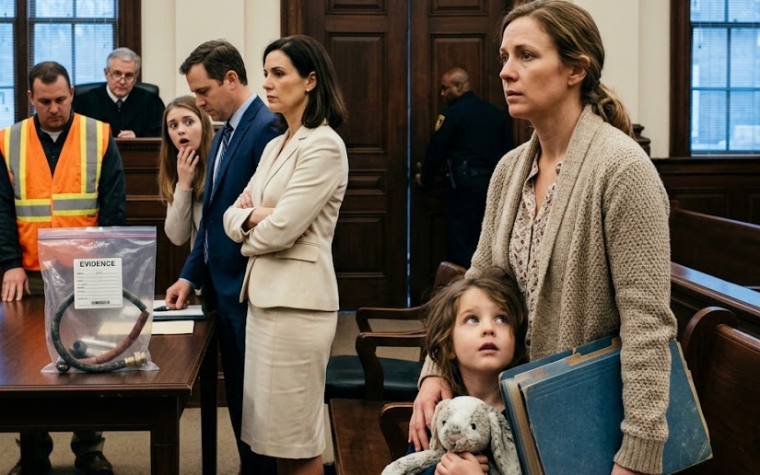
The missing page slid from Erin’s folder at the same moment the court clerk lifted its duplicate from the certified packet.
For several seconds, nobody spoke.
Anthony recognized the page immediately.
He had watched the witness sign it across a scarred interview table three weeks earlier.
The witness had corrected one sentence in the original statement, explaining that the event had occurred after a phone call rather than before it.
Anthony had crossed out the inaccurate wording, written the correction beneath it, and initialed the change.
Then he had done exactly what Erin always demanded.
He had asked the witness to initial the correction too.
The page in the defense lawyer’s hand showed Anthony’s initials and the corrected sentence.
It did not show the witness’s initials, signature, or the continuation notation directing the reader to the next page.
The complete packet did.
Erin placed her copy on the document stand and aligned it with the clerk’s certified copy.
Every mark matched.
The witness’s initials appeared beside Anthony’s.
The signature appeared at the bottom.
The filing stamp showed that the report had been submitted three weeks earlier, not altered later as the lawyer had claimed.
The judge removed his glasses and looked toward the defense table.
“Counsel,” he said, “where did you obtain the page you presented?”
The defense lawyer glanced down at the single sheet in his hand.
The confidence that had filled his voice moments earlier was gone, but he recovered quickly.
“It was included in discovery.”
Erin remained standing.
“The complete packet was included in discovery.”
“That is your representation.”
“No,” Erin said.
“It is yours.”
She reached into the folder and removed a receipt.
Anthony knew that receipt too.
Every discovery packet leaving Erin’s office had a numbered cover sheet listing the enclosed reports and their page counts.
Defense counsel or an authorized representative signed the sheet when the packet was received.
The lawyer’s signature appeared at the bottom.
Erin handed the receipt to the clerk.
“Five-page investigative report,” she said.
“Received in full.
Signed by counsel two days after filing.”
The judge compared the receipt with the certified packet.
The defense lawyer stood.
“A receipt does not prove every page was present.”
Anthony almost laughed.
It was the sort of argument a person made after discovering that the first escape route was locked.
Erin did not smile.
“That is true,” she said.
“Which is why the packet was scanned before delivery.”
She removed one more item from the folder: the certification from her office’s records clerk.
The scan itself was not displayed for the gallery, but the certification identified the document count, the time of scanning, and the unique control number assigned before the packet left the district attorney’s office.
Five pages.
The same five pages now resting in the court’s certified folder.
The defense lawyer objected, arguing that Erin was presenting evidence without proper notice.
The judge reminded him that he had introduced the disputed page and accused an investigator of misconduct in open court.
Erin was entitled to answer the accusation.
The lawyer changed direction.
He claimed the witness’s initials might have been added before filing but after the interview.
He suggested Anthony had pressured the witness.
He demanded that the court examine Anthony’s methods rather than become distracted by paperwork.
Anthony listened without moving.
Every instinct in him wanted to stand, point across the courtroom, and tell the lawyer exactly what he thought of a man who cropped a document and then preached about honesty.