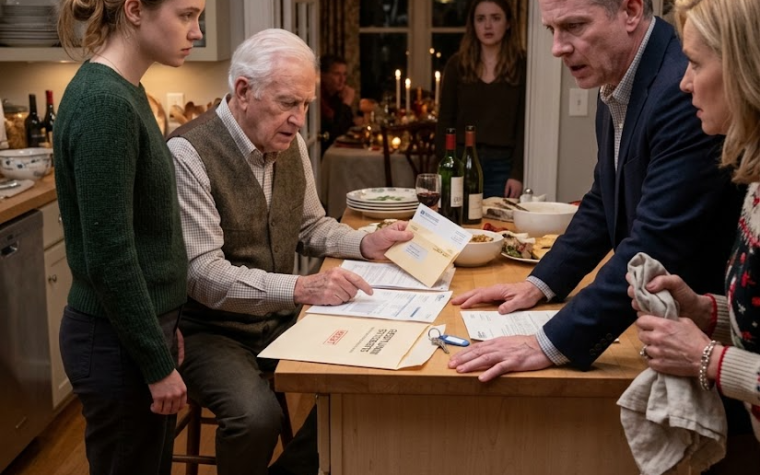
Diane slid the bloodstained envelope across the table.
Frank saw the name written on it—and went white.
The handwriting belonged to the young engineer in the photograph.
The man I had loved.
Owen’s father.
Frank remained on his knees, staring at the envelope as though it had risen from a grave.
Across the street, the black SUV idled beneath a dead maple tree.
Its tinted windows reflected our house back at us.
“Where did you get that?” Frank whispered.
Diane lowered herself into a chair.
Her fingers were shaking so badly that the envelope rattled against the table.
“He gave it to me the night he disappeared,” she said.
For ten years, my mother had hidden it inside the lining of an old winter coat.
She had moved it twice whenever strangers searched the house—first beneath a loose floorboard, then into the pocket of the blue dress she wore only on Sundays.
I had remembered her clutching that pocket on the night Frank expelled me.
I had assumed she was trying to hold herself together.
She had been protecting evidence.
Owen stood close to my side, his eyes fixed on the photograph.
“Mom,” he said quietly, “is that my dad?”
I looked at the smiling man in the hard hat.
“Yes.”
His name was Elias Ward.
He had been twenty-six when we met, a newly promoted process engineer at Silver Creek.
He spoke softly, listened carefully, and carried a small notebook everywhere he went.
While other people in Albany joked about the orange haze, Elias measured it.
He recorded which stacks were active, which alarms sounded at night, and how many workers became sick after certain production runs.
He believed the plant was releasing untreated chemical waste after midnight, when inspectors were gone and most of the town was asleep.
My father had helped him.
Frank had access to maintenance logs showing that pollution-control equipment was being deliberately bypassed.
He had copied dates, valve numbers, and repair orders for Elias.
The two of them had taken the photograph outside the plant after Elias told him they finally had enough evidence to force an investigation.
Then the plant’s owner discovered what they were doing.
Frank pulled himself into a chair.
“They took me into the old loading office,” he said.
“Three men.
No company badges.
They put photographs of you and your mother on the desk.”
His voice cracked.
The men told him Elias had stolen proprietary files and fled.
They claimed he had used me to gain access to Frank and had never intended to stay.
Then they played a recording of Elias saying my name and talking about sending evidence out of Albany.
“They cut the recording,” Frank said.
“Made it sound like he was taking you with him because you knew too much.”
The owner’s men gave Frank a choice.
He could publicly reject me, sever all contact, and convince the town that my pregnancy had brought disgrace into the family—or they would make my disappearance look like an accident.
A bus crash.
A fall near the river.
A frightened pregnant girl who had run away and never returned.
Frank believed driving me out was the only way to make me leave Albany before the men acted.
He had not hated me.
He had staged my rejection while the black SUV watched from the end of the street.
“I thought Chicago was far enough,” he said.
“I thought if they saw me slam the door, they’d believe you had nothing I wanted.”
The explanation did not erase the bus terminal, the hunger, or the months I had spent giving birth and raising Owen alone.
It did not restore the nights I had cried silently because I believed my parents had chosen shame over me.
But it changed the shape of the wound.