My accounting training made the financial files easy to understand.
The environmental reserve had not disappeared through business losses.
It had been transferred through shell companies controlled by the owner.
Payments had also been made to inspectors, physicians, and a county clerk who certified the forged ownership documents.
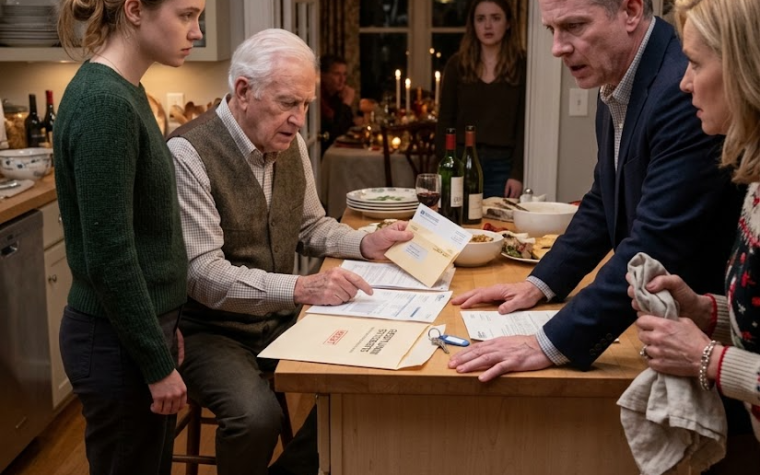
Then I found a folder labeled INCIDENT 4.
Inside was security footage from the night Elias disappeared.
The camera angle showed a corridor near the records building.
Elias ran into view with blood on his sleeve.
Two men followed him.
One struck him from behind.
The footage ended as they dragged him toward a service exit.
Frank turned away.
“They told me he escaped,” he said.
“Then they told me he died in another state.
Then they showed me a letter saying he had blamed me for everything.
Every few months, they changed the story.
I stopped knowing what was real.”
That was the manufactured nightmare that had ruled my father for a decade.
The owner did not need Frank to believe one lie.
He needed him to distrust every possible truth.
Another file contained the original audio recording the men had played for him.
Elias’s uncut voice filled the room.
He said he was sending the evidence out of Albany.
He said he wanted Frank to take Diane and leave.
He said I could not be told where the master files were hidden because the owner’s men were watching me.
Then came the sentence that had been removed.
“I love Hannah, and I will come back for her and our child when this is over.”
Frank covered his face.
Owen stood perfectly still.
The SUV’s engine stopped outside.
A car door closed.
Then another.
Someone knocked three times.
Frank rose in panic, but I caught his wrist.
“I didn’t come back unprepared.”
Before boarding the bus in Chicago, I had created duplicate copies of the USB.
One had gone to an environmental law clinic.
Another had been delivered to a state investigator with instructions to open it if I failed to call by six that evening.
I had also scheduled the financial ledger to be sent to three reporters.
The hidden drive was no longer the only copy.
For the first time, the men outside could not silence the evidence by taking it from us.
The knocking came again.
A voice ordered Frank to open the door.
Diane reached for Owen, but he did not move.
He looked at the photograph, then at the bloodstained message.
“Was my dad trying to save the town?” he asked.
“Yes,” I said.
“And now we finish what he started.”
I called the investigator and placed the phone on speaker.
The owner’s men entered through the back door before the call connected.
They had a key, proof that Frank and Diane had never truly been safe in their own home.
One man moved toward the laptop.
Frank stepped between them.
For ten years, fear had bent his shoulders and lowered his voice.
Now he stood upright.
“You’re too late,” he said.