“Then let’s look at that.”
His attorney whispered, “Michael, stop.”
But the damage was already done.
Grace pulled out records from the restructuring.
Several years after opening, Michael had reorganized the restaurant under a new business entity.
He had repeatedly told me it was routine and that nothing about our ownership had changed.
The filing listed Michael as the controlling manager.
But attached to the internal documents was a consent agreement bearing both our signatures.
My interest had not vanished.
It had been described differently.
Grace then produced bank records showing that profits from the restaurant had funded joint assets for years before Michael began redirecting distributions into accounts I could not access.
The judge’s questions became sharper.
When were those accounts opened?
Who authorized the transfers?
Why had certain distributions not appeared on the financial disclosures already submitted in the divorce?
Michael’s attorney asked for a recess.
The judge granted fifteen minutes.
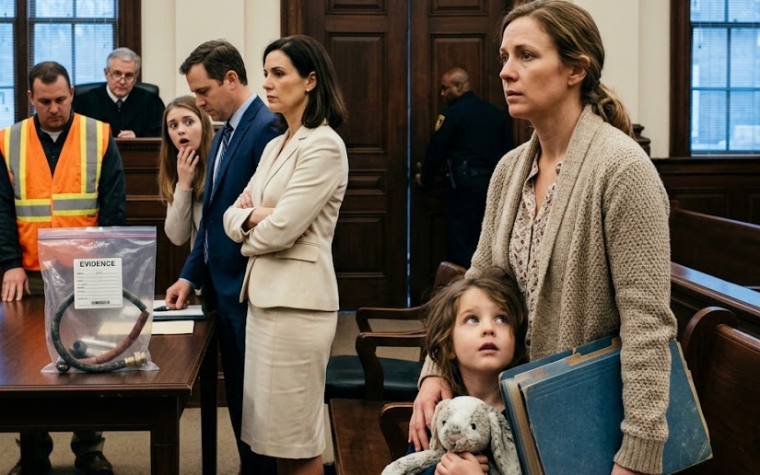
As soon as she left the bench, the courtroom erupted into whispers.
Michael stood so fast his chair nearly tipped over.
He walked toward his attorney, speaking in a low, furious voice.
Brittany followed.
“You told me she had nothing to do with the company,” she said.
“Not now.”
“You said she was trying to take what you built.”
“Brittany.
Not now.”
She looked at me across the room.
For the first time, there was no mockery in her expression.
Only uncertainty.
Michael noticed.
“Don’t look at her like that.”
His voice carried farther than he intended.
Several people turned.
Grace touched my elbow and guided me toward the side of the courtroom.
“He’s doing our work for us,” she murmured.
I looked at the blue folder.
“Is there enough?”
“There’s enough to force questions he clearly did not expect to answer today.”
That was all she promised.
No dramatic guarantee.
No fantasy of instant justice.
Just questions backed by records.
When court resumed, Michael returned without his earlier swagger.
His attorney announced that they disputed the interpretation of the historical business documents and requested additional time to address them.
Grace agreed that further financial review might be necessary.
Then she raised the issue that changed the entire direction of the hearing.
The bank records suggested Michael had failed to disclose business-related assets and transfers during the divorce process.
The judge’s face hardened.
“Mr.
Carter,” she said, “were these accounts included in your financial affidavit?”
Michael looked at his attorney.
His attorney did not answer for him.
“Some of them are operating accounts,” Michael said.
“That was not my question.”
He swallowed.
“I would need to review the affidavit.”