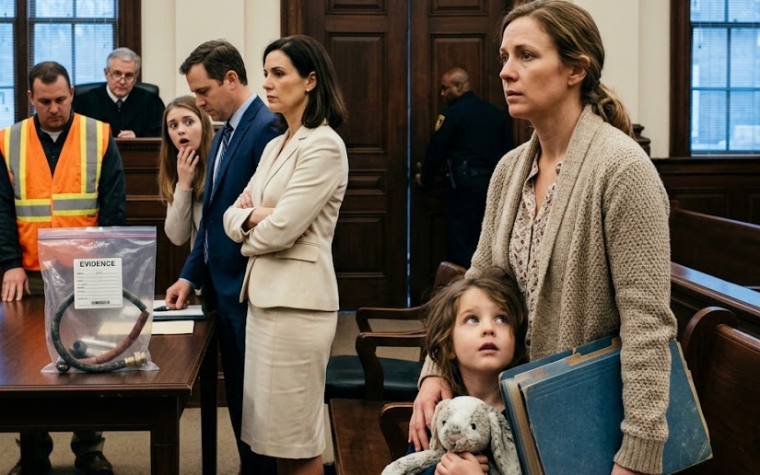
The judge ordered a more complete forensic accounting and directed that relevant business records be preserved.
Victor objected immediately.
“There is no reason to tear apart my company because she’s angry.”
The judge’s voice became colder.
“This is not being ordered because Mrs.
Hale is angry.
It is being ordered because your statements are inconsistent with the documents before this court.”
That silenced him.
The hearing continued for hours.
By the afternoon, Victor no longer leaned back in his chair.
His jacket was open.
His tie was loose.
He spoke almost entirely through his attorney.
Melissa disappeared during a break.
When court resumed, her seat stayed empty.
I noticed Victor look at it twice.
I felt no triumph over that.
For years I had imagined that if the truth ever came out, I would feel powerful.
Instead, I felt tired.
The truth wasn’t glamorous.
It was a stack of old records, scars that hurt when the weather changed, and memories of a younger version of myself believing silence was the price of keeping a family together.
But something inside me had changed.
Victor’s story no longer controlled the room.
Over the following weeks, the accounting produced exactly what Grace believed it would: a much clearer picture of how the restaurant had grown during the marriage and how deeply my labor and our shared resources had supported it.
The court did not suddenly declare that I alone owned the restaurant.
That had never been the point.
Instead, the fantasy Victor had built his case around—that I was an irrelevant bystander to his success—collapsed.
The business was valued as a major marital asset subject to division under the court’s authority.
My contributions could no longer be dismissed merely because Victor had spent years refusing to give them a title.
The contradictions surrounding my workplace injuries were preserved as well.
The judge made clear that the divorce court would not decide every insurance, employment, or tax question raised by the documents, but copies of relevant records could be provided to the proper authorities for separate review.
That was the part Victor had feared when he first saw the blue folder.
The restaurant was no longer the only thing at risk.
His carefully constructed reputation depended on people believing the same simple story: Victor Hale had built everything himself, treated people well, and had nothing to hide.
The documents told a messier story.
A wife who had worked beside him for decades.
An injury he minimized.
Records that contradicted his public claims.
Financial information that now required closer examination.
People who had once stayed silent were suddenly willing to answer questions.
Victor’s lawyer stopped joking with him in the hallway.
The confidence disappeared from his voice.
At the final stage of the divorce, Victor tried one last time to frame me as vindictive.
He said I was trying to destroy the restaurant because our marriage had failed.
I listened until he finished.
Then I spoke.
“I don’t want to destroy what I spent twenty years helping build,” I said.
“I want the court to stop pretending I wasn’t there.”
That was all.
No speech about revenge.
No celebration.
I had spent too many years being told that my work counted only when Victor needed it and disappeared when I needed recognition.
The court entered a division of the marital estate based on the fuller valuation, not Victor’s version of my worth.
The restaurant remained operating, but Victor could no longer treat its entire value as though it had appeared from his hands alone.
The financial settlement reflected the years of shared sacrifice and the reality revealed by the records.
Separate questions raised by the accident reports and business filings continued through the appropriate channels.