No one touched a glass now.
No forks moved against plates.
“They didn’t die,” Lily continued.
“There wasn’t some tragedy that left us surrounded by people trying to help.
They chose other lives.
Rebecca was twenty-one.”
Charles looked down at the floor for the first time all evening.
Lily’s voice became steadier.
“She worked double shifts at a diner.
She took night classes.
She came home exhausted and still made sure I had what I needed for school the next morning.”
I closed my eyes for a second.
Memories arrived with embarrassing clarity.
A kitchen table covered in overdue notices.
A bowl of cereal Lily ate for dinner because I had burned the cheap casserole while trying to study.
The first school form that asked for a parent’s signature and the long moment I spent staring at the blank line before writing my own name.
Lily kept talking.
“She taught herself to braid my hair because I cried before picture day when I realized Mom wasn’t coming back to do it.
She sat through parent meetings when she was barely older than some of the teachers’ students.
She went to my doctor appointments.
She came to every school play she could get out of work for.”
Someone at a nearby table quietly set down a champagne glass.
Lily looked toward Charles again.
“You called her a charity case because she didn’t arrive here with your kind of background.
But there was no charity.
Nobody rescued us.”
Her voice cracked on the final word.
I stepped toward her, but she raised her hand.
She wanted to finish.
“When I graduated high school, Rebecca was there.
When I went to college, Rebecca paid my tuition.”
That produced the first visible reaction from Charles.
His head lifted.
“You paid?” he asked me.
The question was so sincere in its disbelief that several guests turned toward him.
I nodded.
“Yes.”
Charles stared at me as though the information had violated some private calculation.
I knew what he had assumed.
He had heard enough about our childhood to imagine me permanently frozen inside it: poor, struggling, dependent, grateful to be allowed near wealth.
He had never considered that thirteen years of responsibility might have produced competence instead of helplessness.
More importantly, he had never cared enough to ask.
“I thought—” he began.
“I know,” I said.
Those two words seemed to bother him more than anger would have.
Because everyone knew what came after them.
I know what you thought.
I know why you thought it.
And now everyone else knows too.
Charles tried to recover.
“Well, clearly I was making a joke.”
Nobody laughed.
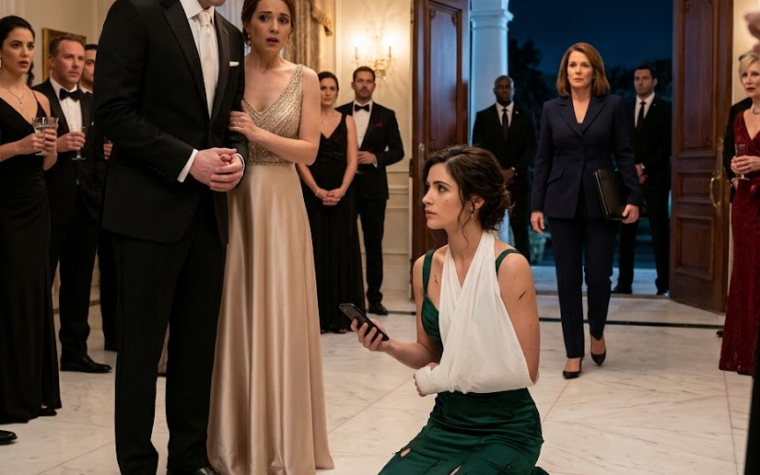
He looked around the ballroom, expecting someone to rescue him with a smile.
No one did.
A man at one of the tables near the front slowly lowered his eyes.
An older woman beside him shook her head.