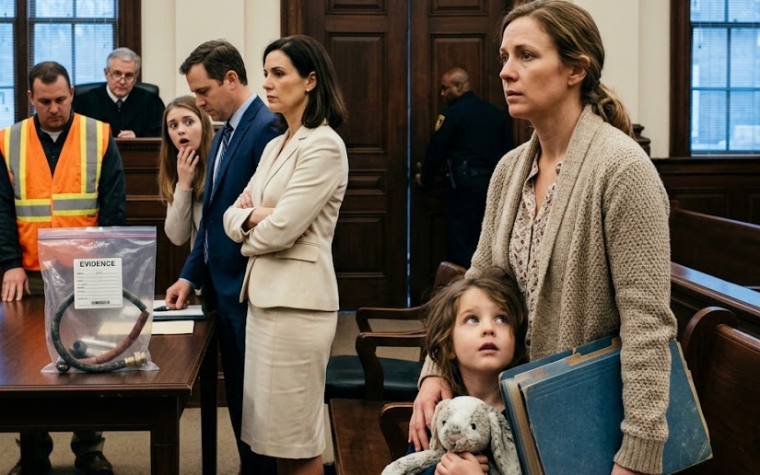
The work explains why you needed to burn it.”
Behind him, Irene’s smile had disappeared.
She looked down at the watch on her wrist, unfastened it, and placed it inside her handbag.
Robert noticed.
“Do not start,” he snapped at her.
She rose and moved to the far end of the courtroom without answering.
When the hearing resumed, Rebecca presented enlargements of the surviving contract sections.
The ownership clause was intact.
So was the provision requiring both signatures before either partner could transfer, pledge, or conceal business assets.
A handwritten notation beside that clause matched Robert’s writing on the photograph: No decisions without both of us.
Robert’s lawyer argued that the contract might have been abandoned through later conduct.
Rebecca answered with Robert’s own messages.
Even after my name vanished from public documents, he continued seeking my approval when the business faced major expenses.
He treated me as an owner when he needed my judgment and as unpaid labor when outsiders were watching.
The judge asked Robert to testify.
His lawyer whispered to him for several seconds before Robert took the chair.
“Did you sign an agreement giving Mrs.
Fox half of Harvest Table?” the judge asked.
“I signed many things twenty years ago.”
“That was not my question.”
Robert swallowed.
“There may have been a preliminary paper.”
“Did you burn it?”
“No.”
“Then why did you tell the court it no longer existed?”
“I assumed she was referring to something else.”
“What else did you believe she had accused you of burning?”
Robert looked at his lawyer again.
The silence lasted long enough to become an answer.
Rebecca then asked him about the hospital report.
Robert claimed he had been confused.
She asked about my missing salary.
He said we had shared household money.
She asked about the transfers from my mother’s account.
He called them a family gift.
“To you personally?” Rebecca asked.
“To the restaurant.”
“Which you now claim belonged only to you?”
Robert’s jaw tightened.
“Yes.”
“Then why does the transfer memo say Matilda ownership contribution?”
He had no answer.
By the end of his testimony, the story he entered the courtroom with had collapsed.
I had gone from a wife who carried sacks to a woman whose money opened the doors, whose records tracked every dollar, whose decisions kept the business alive, and whose signature stood beside his on the agreement he tried to destroy.
The judge did not issue the final divorce ruling that day.
Instead, he ordered Robert not to sell, transfer, borrow against, or remove funds from any Harvest Table location.
A neutral financial review was appointed.
All business records were to be preserved.
The attempted destruction of the contract would be addressed through a separate sanctions hearing and referred for further review if the evidence supported it.
Robert’s control stopped before he left the courthouse.
Over the following months, the financial review confirmed what the notebooks had already shown.
My mother’s money funded the opening.
My unpaid labor preserved cash during the restaurant’s most fragile years.
Major expansion decisions had repeatedly been sent to me for approval.
Robert had publicly erased me while privately relying on my authority.
The burned contract was examined alongside photographs, messages, bank records, and handwriting samples.