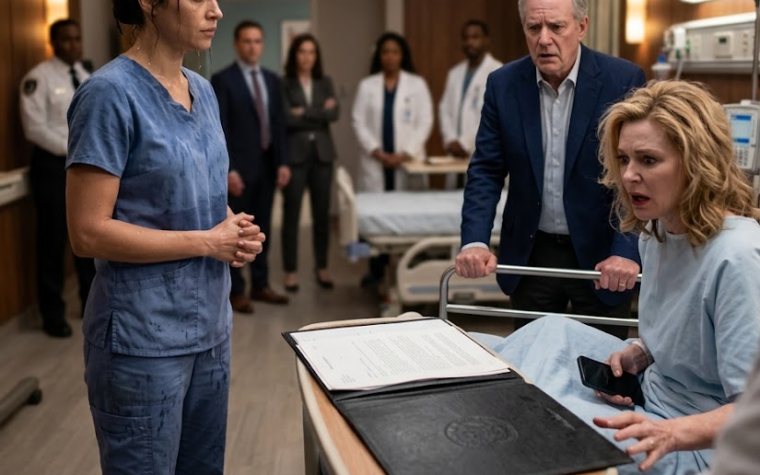
According to him, she fainted after hearing the doctor’s explanation.
His sisters first denied it, then cried, then began arguing about whether the hospital could be trusted.
His brothers said little.
His new wife did not comfort any of them.
Instead, she asked one question.
“What happened to your first wife?”
My ex-husband told me he could not answer her.
Not honestly.
Because an honest answer would have required him to admit that his family had destroyed a marriage over a problem that had never been proven to belong to me.
And it would have required an even uglier confession: he had possessed evidence that the problem might be his.
“She knows about this report?” I asked.
“Yes.”
“Everything?”
“Everything.”
I felt no satisfaction in imagining their arguments.
There had been a time when I dreamed of the day his family might discover they were wrong.
In those early months after the divorce, when I cried alone, I imagined his mother coming to my door and apologizing.
I imagined his sisters lowering their eyes.
I imagined my husband realizing what he had lost.
But standing there years later, I felt something different.
Distance.
Their regret could not return the years I spent believing I was defective.
It could not erase the humiliation.
It could not give me back the woman I had been before they taught me to measure my worth by whether I could become pregnant.
“Did your mother know about the old test?” I asked.
He hesitated.
That hesitation told me there was more.
“She knew I had gone for testing,” he admitted.
“She didn’t know the exact result at first.
I told her the doctor wanted more tests.”
“And what did she say?”
He stared at the floor.
“She told me not to tell you until I was sure.”
I almost laughed, but there was nothing funny in it.
“You were never sure because you never went back.”
He nodded.
“I was afraid.”
“So you let me be afraid instead.”
He began crying again.
“I know.”
“No,” I said.
“You know now.
Back then, you chose not to know.
There is a difference.”
He covered his face with both hands.
For a moment I saw the man I had once loved.
The man who had sat beside me in hospital waiting rooms.
The man who had held my hand after another negative result and promised that we were a team.
Then I remembered how easily that man disappeared when his family offered him someone else to blame.
He lowered his hands.
“I came to ask you to forgive me.”
I looked at him for a long time.
“Are you asking because you care what you did to me, or because you cannot live with what it says about you?”
His face tightened.
“Both,” he admitted.
It was the first fully honest thing he had said since walking through my door.