For a moment, I could not speak.
There it was—the belief beneath every demand he had made of me.
Because I was strong, I was expected to absorb what would have been unacceptable for anyone else.
My strength had become his excuse for refusing to protect me.
“I was strong,” I said.
“That is why I documented everything.
That is why I left.”
His eyes filled.
“What about our daughter?”
“She will grow up knowing that love does not require her to stand still while someone hurts her.”
He whispered that he could change.
I believed change was possible for people who accepted responsibility.
But belief did not require me to return and test it with my body or my child.
“I hope you do,” I said.
“You will do it away from us.”
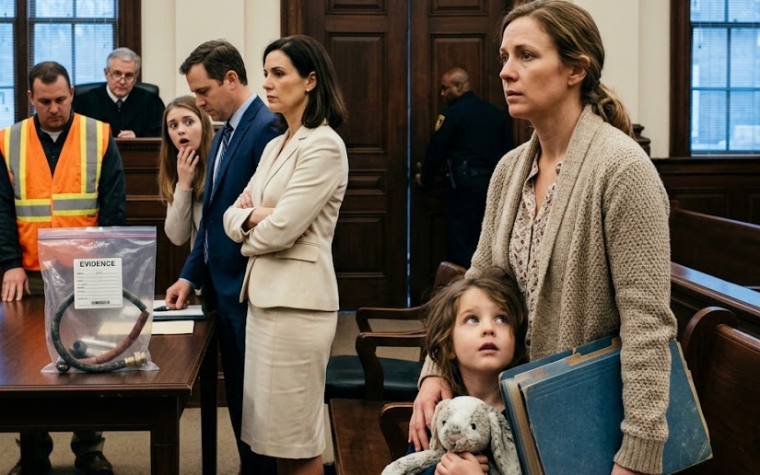
The assault case ended with consequences Minh could not explain away as a private family dispute.
The recording and medical evidence supported the charge, and his changing accounts damaged his credibility.
The court imposed penalties, required intervention counseling, and restricted contact under protective conditions.
The separation became permanent.
Mrs.
Lan never apologized.
She continued insisting that I had destroyed the family.
But her authority depended on secrecy, and secrecy was the one thing she no longer possessed.
Months later, my daughter was born healthy.
When the nurse placed her against my chest, she opened her eyes for only a moment before curling one tiny hand against my skin.
I thought of the silence after the slap, the desperate seconds when I had begged her to move, and the flutter that finally answered me.
I named her after no one in Minh’s family.
I chose a name that meant clarity.
My former colleague stood beside the hospital window holding a folder.
Inside were the final separation documents and confirmation that the remaining recordings had been preserved.
She did not hand them to me until I asked.
“You were right,” I told her.
“About what?”
“That night near the stairs.
You said I should prepare before I confronted them.”
She shook her head.
“You saved yourself.
I only reminded you that the woman who used to command a courtroom was still there.”
After my maternity leave, I returned to legal work slowly.
I did not become the woman I had been before marriage.
That woman had believed intelligence alone could protect her from people she loved.
I became someone more careful and more compassionate.
When frightened clients apologized for not leaving sooner, I never asked why they had stayed.
I asked what they needed to leave safely.
The house remained with Minh and his mother.
For a long time, I expected that fact to hurt.
Instead, whenever I pictured its polished floors and quiet hallways, I remembered the cameras watching from above while two people mistook my silence for surrender.
Mrs.
Lan had been right about one thing.
My name was never on the papers.
But the house had never been my future.
My future was sleeping in a crib beside my bed, breathing softly with one hand curled near her face.
One evening, as I closed a case file at my new desk, my daughter stirred.
I lifted her into my arms and walked to the window.
The city below was bright, crowded, and open in every direction.
For years, Mrs.