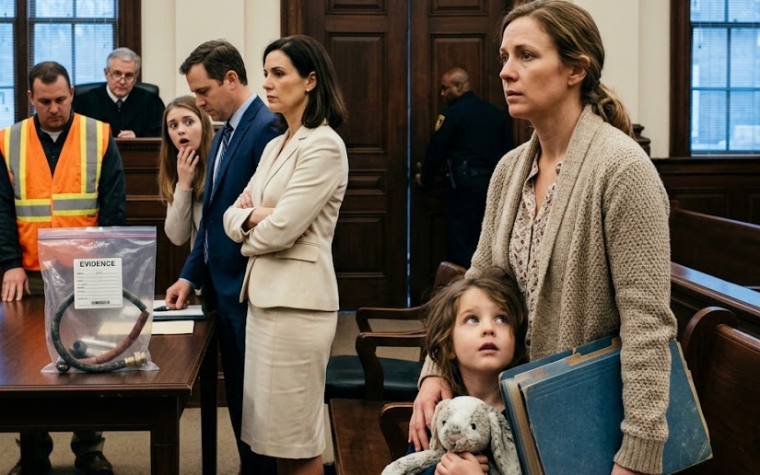
“No,” my grandmother said.
“It never did.”
Lucas was still standing in the doorway.
He looked from the envelope to our father.
“Dad,” he whispered, “what did you do?”
My father twisted toward him.
“Go inside.”
Lucas did not move.
Mara broke the seal.
She removed a notarized statement, a stack of account records, copies of letters, and an original trust amendment bearing several signatures.
The first document was a sworn declaration written by my mother during the final months of her illness.
Mara read it aloud.
My mother described how my father had repeatedly pressured her to dissolve the trust and transfer the house into his name.
When she refused, he tried to convince her that I would be incapable of managing an inheritance.
He demanded control of the educational fund and argued that, as my father, he should decide how every dollar was used.
She had refused again.
The statement explained why my grandmother had stayed away.
My father had threatened to take me across the country and cut off all contact if she interfered before I turned eighteen.
My mother feared a custody battle would leave me trapped between them while she was too ill to protect me.
So she created conditions.
My grandmother and Mara would monitor the trust from a distance.
My father could remain in the house only while providing lawful care.
On my eighteenth birthday, control would pass to me.
If there was credible evidence that I had been harmed, the trust could intervene immediately.
My mother had not abandoned me to him.
She had built a wall around everything she could not stay alive to defend.
My father shook his head.
“A statement from a dying woman proves nothing.”
Mara lifted the account records.
“These are not statements of opinion.”
The records showed withdrawals made from restricted accounts using authorization forms that carried my name.
I had never seen the forms.
The signatures were supposed to be mine.
They were not.
My father claimed the money had paid for household necessities.
Mara pointed to purchases that had nothing to do with me: luxury travel, private club dues, jewelry, electronics, and the down payment on a vehicle registered to Keisha.
The gold watch on his wrist had been purchased three days earlier using money drawn from an account labeled for my winter educational expenses.
Keisha stared at it.
“You told me it was your bonus.”
My father ripped the watch from his wrist and threw it into the snow.
“This is ridiculous.
Families share money.”
“Trustees do not recognize forgery as sharing,” Mara replied.
She lifted another document.
It was a copy of my Hawthorne acceptance letter, sent directly to the trust after the school counselor became suspicious that I had never responded.
Attached was the rejection form.
My name had been signed at the bottom.
Again, it was not my handwriting.
The form stated that I had voluntarily declined the scholarship because I lacked interest in attending.
“I never signed that,” I said.
The police officer beside Mara looked at the page, then at my father.
My father pointed toward Lucas.
“He handled the letter.”
Lucas flinched.
For several seconds, he said nothing.
Then he put the gaming console box down and disappeared into the house.