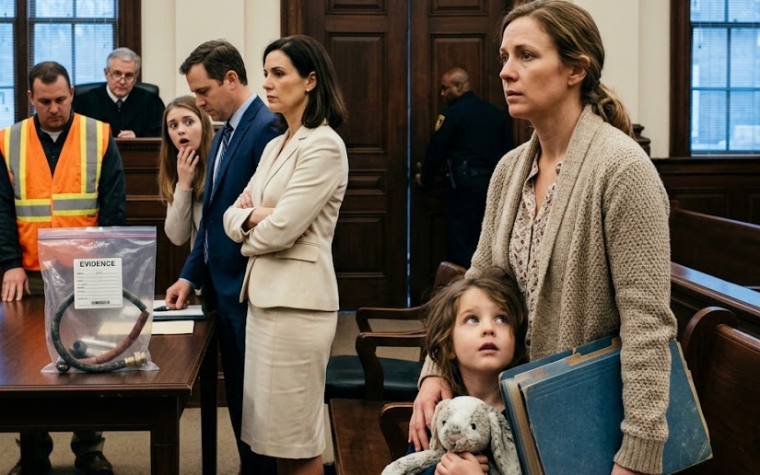
Her cooperation reduced her sentence, but it did not preserve the life she had imagined.
The white blouse, the perfume, and the smile in my kitchen became evidence described in testimony about how confidently she had entered a home financed by deception.
Nathan eventually pleaded guilty after the backup records and Vanessa’s messages made a trial almost impossible to win.
At sentencing, his attorney described him as a builder who had lost perspective under pressure.
The prosecutor described the workers, investors, and communities that had carried the risk while Nathan moved money for himself.
I did not attend.
Neither did Caleb.
We were in our kitchen that morning.
The marble counter was the same, but the settlement folder was gone.
Vanessa’s perfume had faded months earlier.
Sunlight fell across the table where Caleb arranged grapes into rows.
He looked older than he had on the morning Nathan left, though only a year had passed.
“Mom?”
“Yes?”
“Did I ruin Dad’s company?”
I sat beside him.
“No.”
“But my notebook started it.”
“Your notebook helped people find the truth.
The choices were already there.
Your father made them.”
He considered that carefully.
“So noticing isn’t bad?”
“No.
But protecting adults from their own choices isn’t your job.”
Caleb pushed a row of green grapes toward me.
There were ten.
Exactly ten.
For years, Nathan had treated our son’s attention to detail as a defect.
He had mocked the quality that exposed him because he believed power meant deciding which truths mattered.
He was wrong.
Caleb did not need to become normal by Nathan’s definition.
He needed a home where no one punished him for seeing clearly.
I ate one grape and moved the remaining nine into a crooked circle.
Caleb stared at the shape.
Then he smiled and moved one grape slightly farther out.
For the first time, the disorder did not frighten him.
For the first time, neither did the future.