The consequences were not a cinematic collapse.
He did not lose every achievement overnight, nor did everyone who admired him suddenly hate him.
Reality was more precise.
He lost the assumption of trust.
Every room he entered now held a question that had not existed before.
Our divorce was finalized nine months later.
Nathan fought hardest over the story, not the property.
He wanted confidentiality language that would prevent me from discussing the gala.
My attorney reminded his that hundreds of witnesses had attended and that I had made no false statement.
He eventually stopped demanding control over what could no longer be controlled.
Vanessa contacted me once.
Her message was brief.
“He told me you had agreed to separate.
I should have confirmed it.
I’m sorry.”
I read it several times.
Then I replied, “You asked about me at the airport.
Whatever he told you, you knew I still existed.”
She did not write again.
I did not forgive her, but I stopped imagining her as the woman who had stolen Nathan’s best smile.
A smile cannot be stolen if it was being deliberately withheld.
Months after the divorce, my company designed another hospital event.
Not for Nathan’s hospital.
A different one across the river.
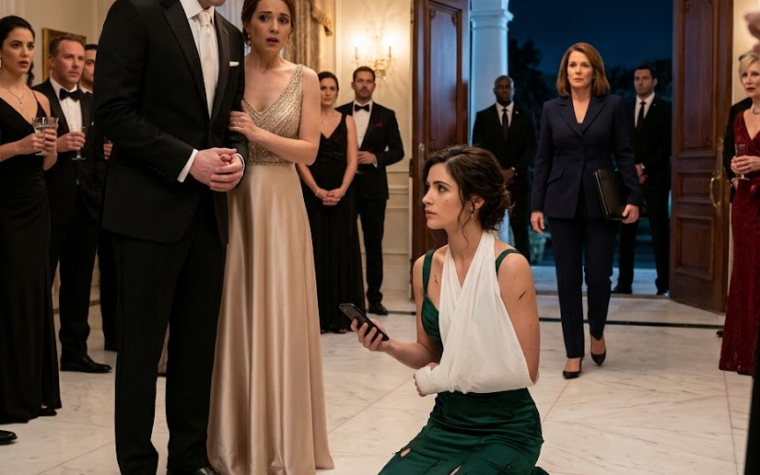
On the afternoon of the installation, I stood in an empty ballroom while my team tested the lights.
White flowers curved around the stage.
Glassware caught the warm glow from the chandeliers.
Every detail was intentional.
One of my assistants asked whether ivory roses still bothered me.
I looked at the arrangements.
For a while, they had.
Then I remembered that flowers did not betray people.
Screens did not humiliate people.
Awards did not create hypocrisy.
People made choices.
Objects only revealed the care behind them.
That evening, I watched guests enter the ballroom and admire the room I had built.
Nobody introduced me as a surgeon’s wife.
Nobody asked whether Nathan would be arriving.
They knew my name because it was printed on the event contract, because my team trusted me, and because the beauty surrounding them had begun as a sketch on my desk.
For fifteen years, I had mistaken restraint for invisibility.
Nathan had mistaken it for weakness.
At the airport, I had believed I was recording the moment my marriage ended.
Later, I understood that I had recorded something else.
It was the moment I stopped allowing another person’s version of me to become my life.
Nathan once told a ballroom full of people that I had taught him loyalty.
He was wrong about that too.
Loyalty was never the lesson I gave him.
The lesson was that silence and ignorance are not the same thing—and a woman who stays calm may simply be waiting for the right moment to press play.