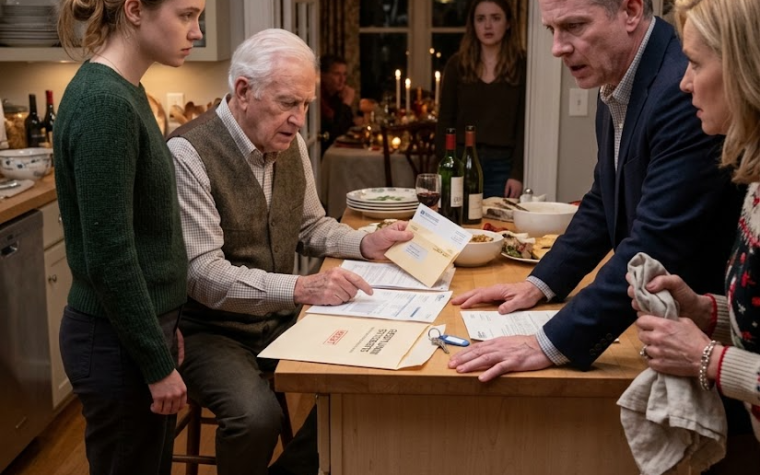
When I left the room, Mark followed me only to say I was ruining the holiday.
None of those moments looked dramatic by itself.
That had always been Mark’s defense.
It was only a joke.
It was only advice.
It was only one dinner.
It was only one apology.
But placed together, the moments formed a pattern that could no longer be disguised as misunderstanding.
The cruelest part was not that Mark’s family disliked me.
It was that Mark had trained me to believe their approval was the entrance fee for my own marriage.
Whenever I resisted, he threatened the thing I feared most: exclusion.
Get out of the room.
Leave the dinner.
Do not come to the next gathering.
And finally, in front of everyone, get out of the house.
Mark had expected the threat to pull me back into obedience.
He had never considered that one day I might accept the invitation.
The immediate decision did not give either of us everything we wanted.
Real life did not transform into a clean victory because I had boarded a plane.
There were interviews, written statements, financial disclosures, and long conversations about Oliver’s routine.
I had to show that the job was stable, the apartment was suitable, childcare was arranged, and contact with Mark could be maintained.
I did not hide where we were.
I did not block appropriate communication.
I sent photographs of Oliver playing in the park and arranged regular video calls at agreed times.
But I also insisted on boundaries.
Mark’s mother would not sit beside him prompting questions.
Rachel would not interrupt.
The calls were for Oliver and his father, not another family tribunal in which I was expected to defend myself.
Mark hated those rules.
During the first call, his mother’s voice drifted from somewhere outside the camera.
“Ask when she is bringing him home.”
I ended the call and documented what happened.
The next call took place with Mark alone.
Oliver was too young to understand the conflict.
He showed Mark a toy airplane, pressed his face too close to the screen, and wandered away halfway through the conversation to find a banana.
Mark watched him go.
For the first time since we left, his anger disappeared.
“He looks different,” he said quietly.
“He is sleeping better.”
Mark looked down.
“Are you?”
I did not answer.
He already knew.
As the process continued, Mark’s certainty began to collapse.
His family had promised that I would fail.
Instead, I completed my first month at the new job.
Oliver settled into childcare.
We found a small house with a fenced garden and a bedroom where he could see a strip of blue water from the window.
My old friend helped me buy a secondhand table.
I assembled Oliver’s bed myself, tightening each screw while he handed me the wrong tool and announced that he was helping.
The life Mark had described as impossible became ordinary one practical decision at a time.
His mother reacted badly.
She sent me a long message accusing me of punishing her for loving her grandson.
She said families argued and mature women forgave.
She said I had humiliated Mark by exposing private matters.
I replied with one sentence.