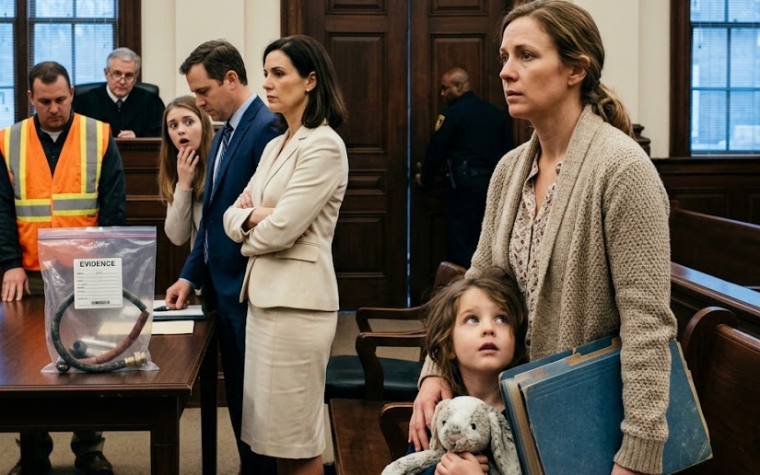
Ms.
Hargrove opened the folder without sitting down.
For the first time that evening, nobody reached for a champagne glass.
She was a compact woman in a navy suit, carrying herself with the careful neutrality of someone accustomed to entering rooms where people were about to become very unhappy.
She had introduced herself quietly in the foyer, but Graham had been too focused on me to hear it.
Now he looked from her to the folder and finally to me.
“What is this?” he asked.
Ms.
Hargrove did not answer him immediately.
She checked the name on the first packet, then stepped toward his side of the table.
“Graham Whitmore?”
His jaw tightened.
“You know who I am.”
“I need you to confirm it.”
He gave a humorless laugh.
“Yes.
Graham Whitmore.”
She handed him the packet.
“You’ve been served.”
Evelyn made a small choking sound.
Sloane’s hand went instinctively to the sapphire necklace.
Graham stared at the papers without opening them.
“Served with what? We’re already getting divorced.”
“That,” I said, “is not the divorce petition.”
His eyes lifted to mine.
For six months, Graham had treated the end of our marriage like a corporate restructuring he had already approved.
He spoke about the house as though it would obviously remain his.
He told friends I would be “comfortable.” He told the children that I would eventually realize fighting him was pointless.
What he did not know was that I had stopped fighting him three months earlier.
I had started documenting him instead.
The first thing my attorney noticed was money moving from one of our joint investment accounts into an entity Graham had never mentioned to me.
The amount was not enough to destroy us.
That was precisely why he thought it would go unnoticed.
Then came a second transfer.
Then a payment for an apartment in Sloane’s name.
Then jewelry.
Then furnishings.
Then a deposit to a private club Graham had once told me we could no longer afford.
Every transaction occurred while our marital estate was still subject to division.
When I confronted him about the first transfer, he smiled and told me I did not understand how our finances worked.
That was the last time I confronted him about anything.
My attorney, Rachel Levin, had looked at me across her desk and said, “If he believes you’re watching, he’ll become careful.
If he believes you’re defeated, he’ll become honest.”
So I became quiet.
Graham mistook quiet for weakness.
By the night of Evelyn’s dinner, we had months of records.
The packet Ms.
Hargrove placed in his hands contained an emergency court order preserving marital assets, restricting further transfers outside ordinary expenses, and requiring disclosure of several accounts and entities that Graham had failed to include in his initial financial statement.
It also required an accounting of certain high-value personal property that had disappeared from our home after we separated bedrooms.
Including the sapphire necklace around Sloane’s throat.
Graham finally opened the packet.
His eyes moved quickly down the first page.
Then slower.
Then back to the top.
“This is ridiculous.”
Nobody answered.