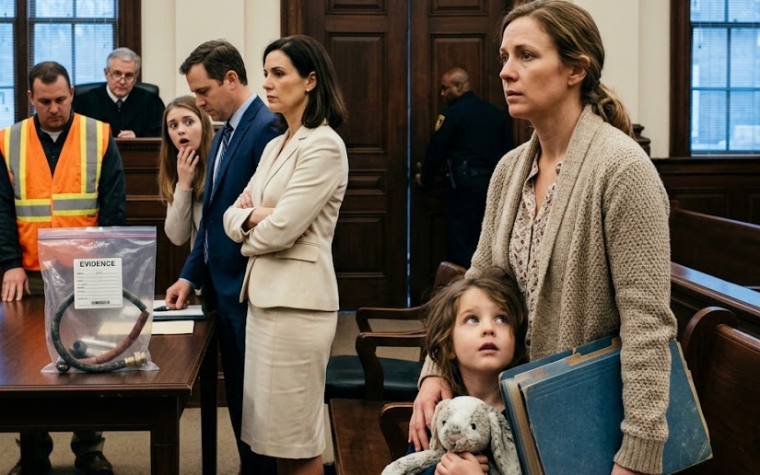
“Not every problem needs to become one of your properties, Nathan.”
She was right.
I attended medical appointments.
I learned that Theo hated peas, Mia loved stories about astronauts, and Jack refused to sleep unless the closet door was completely closed.
I learned how to fasten three coats while someone was asking for juice and someone else was missing a shoe.
The first time I took them to breakfast alone, I forgot Mia’s inhaler and had to turn back before reaching the elevator.
Caroline did not insult me.
She simply held out the inhaler and said, “This is why trust takes time.”
I carried those words everywhere.
News of the scandal eventually reached my board, but not because Caroline sold her story or demanded public revenge.
The legal preservation notices made secrecy impossible.
I addressed the directors myself and accepted responsibility for creating a company culture in which access to me was controlled so completely that the mother of my children could be erased.
Margaret resigned from the charitable foundations and advisory boards that had once displayed her name.
Caroline filed a civil claim over the surveillance, interference, and false statements.
Margaret’s attorneys sought a private settlement.
Caroline accepted only after the agreement included a written admission of what had been done.
She refused any clause requiring silence.
She did not publish the admission.
She simply kept it.
“It’s not for the public,” she told me.
“It’s for the day my children ask why their father wasn’t there.”
Margaret wrote letters to the triplets, but Caroline stored them unopened.
She said the children could decide whether to read them when they were old enough to understand that remorse did not erase danger.
Months passed before Caroline allowed me inside the apartment without arranging the visit through her attorney.
Longer still before she trusted me to keep the children overnight.
We did not pretend the five lost years could be repaired by romance.
I still loved her, but love without accountability had already caused enough damage.
We built something slower: schedules, school pickups, medical decisions, difficult conversations, and proof repeated through ordinary days.
The following spring, we returned to Central Park.
The oak tree was green again.
The bench had dried beneath the sun, and families moved along the path carrying coffee and bright balloons.
Theo climbed onto the bench and examined the wood as if trying to understand why it mattered.
Mia chased pigeons.
Jack held my hand with complete seriousness.
Caroline stood beside me, no longer wrapped in a torn coat, no longer waiting for someone powerful to admit she was telling the truth.
“You know,” she said, “I used to hate this place.”
“And now?”
She watched the children running through the grass.
“Now it’s just a park.”
That was the dignity my mother had tried to take from her—the ability to let a place become ordinary again.
Jack tugged my sleeve.
“Dad, watch this.”
It was the first time any of them had called me that without being prompted.
He jumped from the bench and landed badly, laughing before I could catch him.
I laughed too, though my eyes burned.
For years, I had believed success meant building something high enough that no one could ever look down on me.
But the most important moment of my life began on my knees in the dirt, opening a folder beside a woman I had failed and three children I had never been allowed to know.
I could not reclaim the years that had been stolen.
I could only become the man who never walked past them again.