“I would have believed you.”
“But would the judge?”
I could not give her an easy answer.
“The recording helps adults understand what happened,” I said.
“But you should never have needed to collect proof.
Keeping you safe is our responsibility, not yours.”
She stared at the ceiling.
“Mom said families have to keep secrets.”
“Families can keep surprises.
They should not keep secrets that make children scared.”
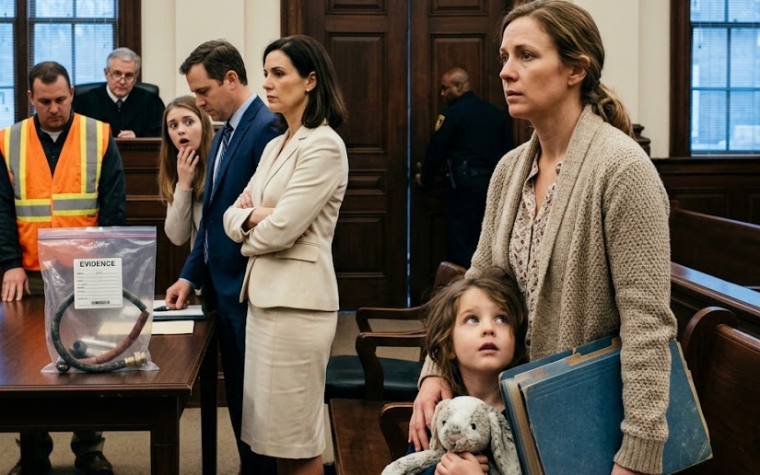
The emergency hearing took place two days later.
Laura arrived with an attorney and a completely different version of events.
She claimed the trip had been a temporary visit.
She said the apartment was a backup plan because our marriage was failing.
She insisted the custody statement was only a private draft written during an emotional moment.
Then she claimed I had manipulated Chloe into making the recording.
Her attorney argued that a frightened child could easily misunderstand an adult conversation.
Mara played the full recording.
It lasted fourteen minutes.
Laura’s voice guided Chloe through each accusation repeatedly.
Whenever Chloe resisted, Laura warned that she might never see her father again unless she cooperated.
Near the end, Chloe asked about the travel form.
Laura answered, “I signed his name.
People barely look at those things.
Once we are through the airport, it won’t matter.”
Laura’s attorney stopped taking notes.
The judge listened without interrupting.
Afterward, Laura said the recording had been edited.
Mara submitted the original phone, its automatic cloud backup, and the file metadata.
A forensic examiner later confirmed that the audio was continuous and unaltered.
The court appointed a child specialist to speak with Chloe privately.
Chloe described the suitcase, the passport, the practice sessions, and Laura’s warning that I would disappear from her life if she told anyone.
She also explained why she had sent the text instead of speaking to me in the hallway.
“Mom was watching him,” she said.
“I thought she would stop me.”
Additional records made Laura’s story harder to maintain.
Three weeks earlier, she had transferred nearly half of our joint savings into an individual account.
Part of the money paid for the apartment deposit and airline tickets.
She had contacted Chloe’s school about withdrawing her.
She had requested copies of medical records without telling me.
A printer log from her work account showed that the forged travel form and custody statement had been printed there.
The signature on the form had been traced from a scanned document I had signed months earlier.
The judge issued temporary sole physical custody to me and restricted Laura to supervised visits.
She was ordered to surrender all copies of Chloe’s passport, disclose the location of the transferred money, and avoid discussing the court case with Chloe.
The judge also referred the forged documents and planned removal to investigators.
Laura did not look at me when the ruling was read.
She looked at Chloe.
For a moment, I saw the old instinct returning—the belief that one expression, one whisper, or one carefully chosen sentence could still pull our daughter back under her control.
The child specialist stepped between them before Laura could speak.
Outside the courtroom, several members of Laura’s family approached me.
Some apologized.
Others said I should have handled the matter privately.
One relative told me that involving attorneys had permanently destroyed the family.
I answered with the only truth that mattered.
“The family was damaged when an eight-year-old was told to lie and disappear.
The court simply stopped it from happening.”