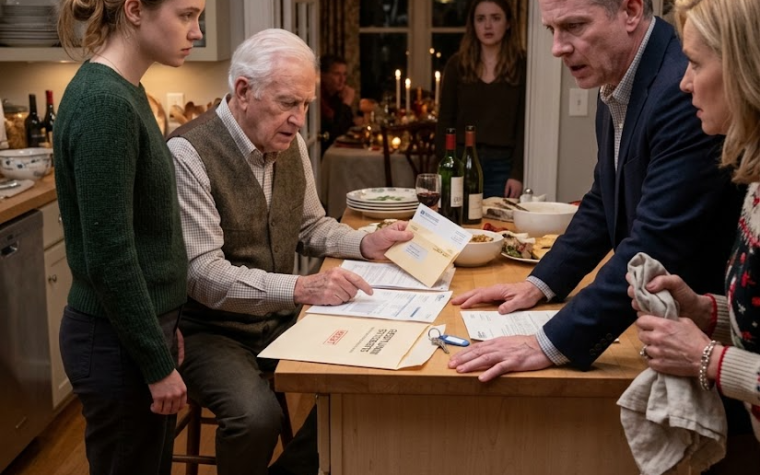
My father made decisions, my mother softened the language, and together they made resistance feel cruel.
Now, with consequences approaching, he handed her the forgery without hesitation.
Margaret’s voice dropped.
“Richard said Claire had agreed.”
“You were standing beside him when he said we would change the locks while I was in Paris,” I replied.
She looked toward the camera again.
“You recorded us?”
“I protected myself.”
“That is not what family does.”
I almost laughed.
Instead, I read the final paragraph of my grandfather’s letter.
Do not let them turn your boundary into a betrayal.
People who benefit from your silence will call your voice cruelty.
Let them.
I folded the letter carefully.
Officer Harper instructed my parents and Olivia to move away from the apartment.
The locksmith packed his tools and provided a written statement.
The realtor forwarded every email and canceled the listing appointment in front of them.
My father refused to move.
“This apartment could solve everything,” he said.
Harper asked, “What exactly is everything?”
The answer came from Olivia.
She had begun crying, but even then her anger was aimed at me.
“You have no idea what they’ll do if I don’t pay.”
My mother told her to be quiet.
Olivia kept talking.
Her debts were not one emergency.
They were a chain of them: unpaid credit cards, personal loans, cash advances, and money borrowed against promises she could not keep.
My parents had covered earlier balances by draining savings and taking a loan against their own house.
The apartment was supposed to erase the final, largest amount.
They had already promised one creditor that money from the sale would arrive within weeks.
My father stepped toward her.
“You are making this worse.”
“No,” I said.
“She’s making it visible.”
That was what my family feared most.
Not wrongdoing.
Visibility.
They could justify almost anything behind a closed door.
Once other people saw the pattern, their certainty collapsed.
Officer Harper did not stage a dramatic arrest in the hallway.
Real consequences arrived more quietly.
He separated them, collected statements, preserved the forged authorization, and informed them that the case would be referred to investigators.
Because they had damaged the lock while attempting to enter against my explicit refusal, they were escorted from the building and formally warned not to return.
My father kept insisting that I would withdraw the complaint.
“She always calms down,” he told Harper.
I heard him through the phone.
“No,” I said.
“I used to give up.”
I reached the apartment an hour later.
Officer Harper was still there.
The locksmith had replaced the damaged deadbolt at no charge after his employer learned how he had been deceived.
The realtor had left me copies of every communication from my parents.
The hallway smelled faintly of hot metal.
My mother stood near the elevator while the officers finished their work.
My father had already been taken to the station for a formal interview after refusing to answer basic questions without attacking everyone else.