Most of all, he lost the certainty that I would remain quiet to protect appearances.
Six months after Emma’s wedding, Helen gave me the final item Dad had left in her care: a small recorder containing a message made three days before his death.
His breathing was labored, and there were long pauses between his words.
“Claire,” he said, “I hope the envelope never reaches you.
I hope I am wrong about him.
Fathers are supposed to want their daughters’ marriages to survive.”
He paused, then gave a faint laugh.
“But not at the cost of the daughter.”
I listened to the message in Dad’s study, sitting beneath the green lamp from the security recording.
For months, that room had felt contaminated by what Daniel, Sloane, and Vivian had planned there.
After Dad’s voice ended, I opened the curtains.
Morning light moved across the desk, the framed photographs, and the chair where he had once taught me equations.
The room belonged to my memories again.
I placed his silver tie clip beside the recorder.
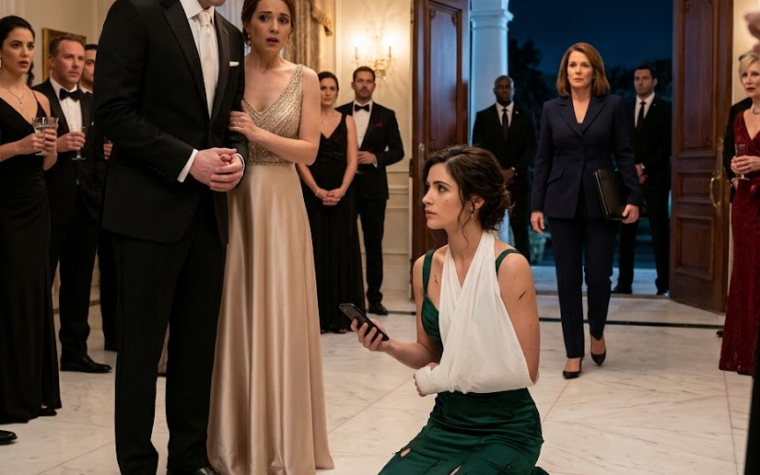
At Emma’s wedding, Daniel had tried to turn my father’s absence into proof that I was alone.
Dad’s note proved the opposite.
He had seen the trap before I could see it.
He had left evidence, counsel, witnesses, and one final instruction strong enough to reach beyond his death.
But the most important thing he left me was not the recording or the protected trust.
It was the moment before I handed the flash drive to Ray—the moment when I understood that restraint was not surrender, and speaking was not the same as making a scene.
Daniel had walked onto that dance floor believing my silence belonged to him.
It never had.