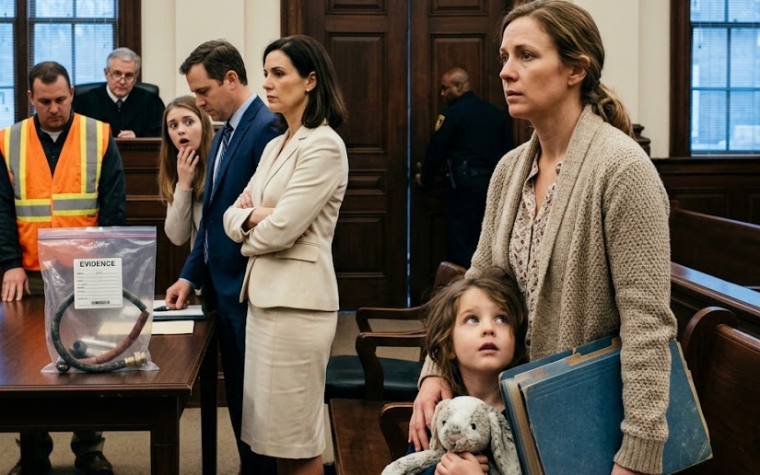
Nathan exhaled sharply.
“Claire.”
I opened the folder.
He stopped talking.
I placed the unsigned authorization on the table first.
Then the alteration slip.
Then the cream card.
I didn’t need to read the note aloud.
Nathan recognized his own handwriting from across the table.
The color disappeared from his face.
Vanessa stared at the card.
Her lips parted.
“Where did you get that?”
“Inside the emerald dress Nathan gave me Friday night.”
Her eyes closed for one brief second.
That was answer enough.
Nathan leaned forward.
“This isn’t what you’re making it look like.”
Emily had predicted that sentence almost word for word.
I looked at him.
“Then tell me what it looks like.”
He pointed toward the card.
“The dress was supposed to be delivered to the hotel.
It ended up with my luggage.
I didn’t realize the note was still inside.”
I almost laughed.
It was the first useful truth he had offered.
“So you gave me another woman’s dress because you accidentally brought it home?”
“I panicked,” he snapped.
“You would’ve asked questions.”
“I did ask questions.
You lied.”
“About a dress.”
The room went silent.
He had said it with such contempt that even Vanessa turned toward him.
About a dress.
As though the dress were the problem.
As though his handwriting weren’t inside it.
As though her name weren’t in the business documents on the same table.
My attorney tapped the authorization.
“Then let’s discuss the paperwork.”
Nathan’s expression hardened.
“I was trying to help my wife.
She has been buried in those businesses for years.
Vanessa’s firm had potential interest from groups that could restructure or acquire part of the operation.
Claire would’ve benefited from having someone handle preliminary negotiations.”
“Without telling me what I was authorizing?” I asked.
“You wouldn’t have understood half the transaction language without spending weeks on it.”
That one landed harder than the affair.
Maybe because it exposed something older.
Nathan had watched me run pharmacies, survive inspections, negotiate suppliers, manage compliance problems, make payroll decisions, and build systems complicated enough that he bragged about them when it made him look good.
Yet somewhere along the way, he had decided my exhaustion made me stupid.
I folded my hands.
“You thought I was capable enough to build the businesses but too tired to read the document that gave you access to them.”
“That’s not what I said.”
“It’s exactly what you did.”