When she returned to collect some personal things, she stood in the doorway where she had given me my 24-hour deadline.
Neither of us mentioned the symmetry.
She looked toward Dad’s chair.
“Did he really want you to have it?” she asked.
I knew she meant the house.
“He wanted it protected,” I said.
“And he wanted the person carrying the responsibility to have the authority that came with it.”
Her eyes filled, but I didn’t move toward her.
“Why didn’t he explain it to me?”
“He tried to talk about money all the time.
You always told him you didn’t want to hear about paperwork.”
She sat down slowly.
For once, she didn’t argue.
I brought out the shoebox of Dad’s letters.
There was one I had reread more than any other, written years before his illness when I was away at college.
He had told me that adulthood was strange because eventually you learned that family love and family fairness were not always the same thing.
People could love you and still take you for granted.
They could need you and resent you for being needed.
They could tell themselves a comforting version of events until the truth felt like betrayal.
I didn’t give the letter to Mom.
It was mine.
But sitting there, I finally understood why I had kept it.
In the weeks that followed, the story spread through the family in several different versions.
In Kendra’s version, I had secretly seized Dad’s house.
In Mom’s earliest version, everything had been a misunderstanding.
In Mark’s version, they should never have arrived with a moving truck before verifying anything.
I stopped trying to control which version people believed.
The documents existed.
The payments existed.
The witnesses existed.
And I no longer needed unanimous approval for reality to remain real.
I repaired the patch of grass where my boxes had sat that morning.
I replaced a cracked dish that had been damaged in the move.
I changed the locks.
Then, one Saturday, I vacuumed the same old rug beneath Dad’s chair.
For years, that routine had felt like evidence that I was trapped in a life nobody appreciated.
That morning it felt different.
The house was quiet.
No moving truck.
No clipboard.
No orders shouted across the lawn.
Just sunlight coming through the front window and Dad’s letters sitting safely in their shoebox.
I had spent years believing that keeping the family together meant absorbing whatever they handed me.
Dad had understood something I hadn’t.
Responsibility without authority eventually becomes exploitation.
That was why he had put things in writing.
And that was why, when my mother gave me 24 hours to surrender the home I had protected, I didn’t need to scream louder than she did.
I only needed to let the truth arrive.
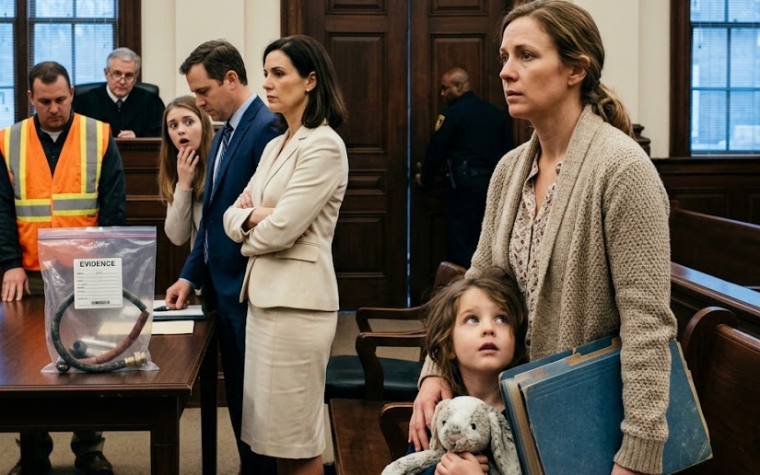
It came in a blue folder, carried up my driveway while my belongings were still lying on the lawn.
By the end of that morning, everything they had tried to take from me was back inside.
But the most important thing I recovered had never been in one of those boxes.
It was the right to stop asking my family for permission to stand on ground that was already mine.