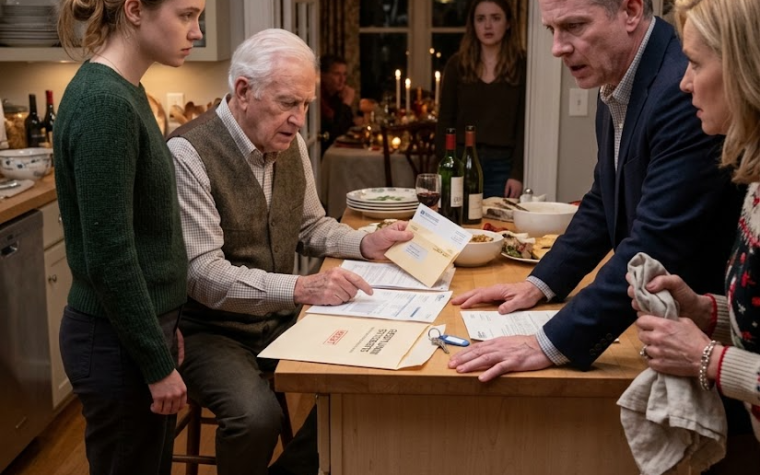
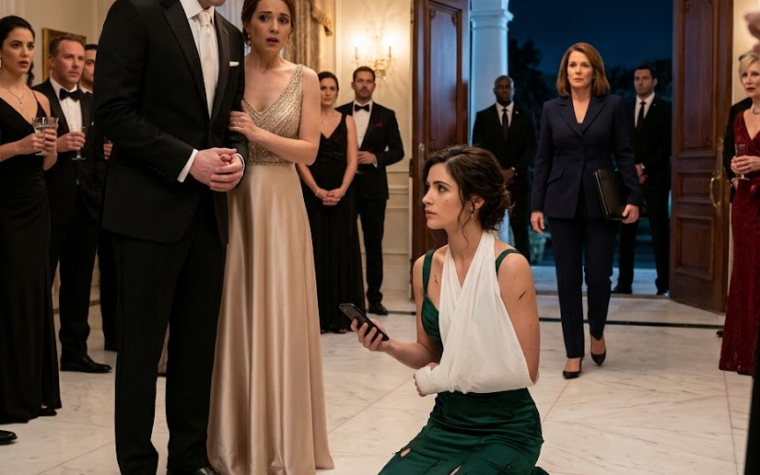
Not even the relatives now staring at me as if I had stepped out of a disguise.
The aide began to read.
The words came in the formal language of authority: service, confidence, responsibility, effective immediately.
Then came the sentence that divided my life into everything before it and everything after it.
“Colonel Emily Anne Harper is promoted to the rank of brigadier general.”
A breath moved through the room.
The aide opened the velvet box.
Inside rested two silver stars for my uniform.
For several seconds, no one applauded.
The truth was too large and too unexpected.
Then an officer in the second row rose and brought his hands together.
Another joined him.
Chairs scraped backward as the entire room stood.
The applause came hard enough to fill my chest.
I looked toward my family.
Joseph remained standing, but his hands hung at his sides.
His wife was clapping with tears in her eyes.
My mother stared at the silver stars as if they had personally accused her.
General Cruz waited until the room quieted.
“This promotion recognizes twenty-one years of exceptional service,” he said.
“Much of Brigadier General Harper’s work could not be discussed publicly.
Some of it still cannot.”
My new rank sounded unfamiliar when attached to my name.
My mother found her voice.
“Emily never told us any of this.”
The general looked at me, giving me the choice to answer.
“I wasn’t permitted to discuss most of it,” I said.
Mom’s eyes flashed with relief.
She had found an explanation that did not require her to examine herself.
“Well, there you are,” she said to the relatives around her.
“It was classified.
How could any of us have known?”
I could have remained silent.
Silence had kept peace in our family for years.
It had allowed Mom to praise Joseph without interruption.
It had allowed Joseph to accept admiration he had not earned.
It had allowed everyone to confuse my restraint with emptiness.
But rank was responsibility made visible.
So was truth.
“When the restrictions were lifted,” I said, “no one asked.”
My mother’s mouth closed.
General Cruz stepped beside me.
“Operation Iron Vale remained classified until last year,” he said.
“The citation can now be summarized.”
Joseph shifted his weight.
I stared at the flags behind the lectern while the general described the night I had tried for years not to remember.
A coalition evacuation route had been compromised.
Forty-six soldiers, advisers, and medical personnel were moving toward a crossing that intelligence had identified as secure.
Minutes before they arrived, I recognized that an intercepted transmission contained information only someone inside the operation could know.
I ordered the convoy to stop.
The senior officer above me demanded that we continue.
Aircraft were already committed.
Fuel was limited.
Delaying meant risking daylight exposure and the collapse of the evacuation window.
I refused the route anyway.
For twenty-three minutes, I carried responsibility for forty-six lives while two command posts told me I was wrong.