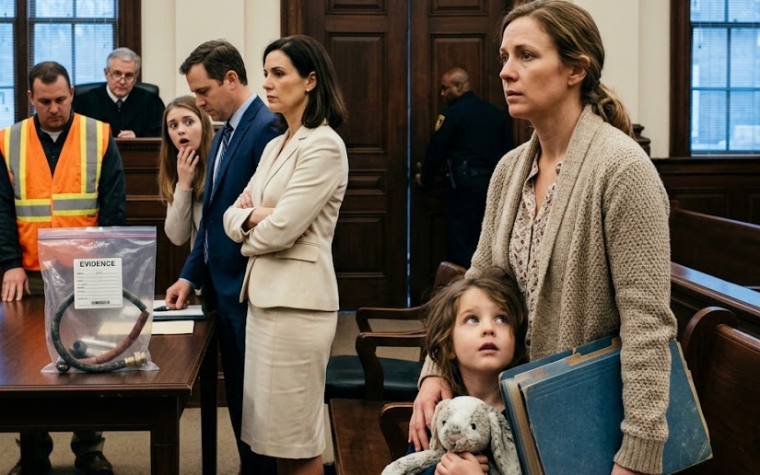
Lauren shouted, “Stop telling her things.”
That was the first crack between them.
My mother had always defended Lauren because defending her preserved the family roles.
Lauren remained fragile.
My mother remained necessary.
I remained useful.
But the moment the money vanished, Lauren no longer sounded fragile.
She sounded furious.
Scott unmuted himself.
“Jacqueline, the tracker is stationary at an airport hotel north of the city.
The bank has blocked profile changes, replacement credentials, and verbal authorization attempts.
No funds can move.”
My mother heard him.
“Who is that?”
“My banker.”
“You involved a banker in a family misunderstanding?”
“You involved a banker when you took a bank authorization bag.”
The silence that followed was different.
My mother had believed she could define the event before anyone else saw it.
She could call theft borrowing, entitlement compassion, and betrayal a misunderstanding.
Scott’s voice meant someone outside the family had heard her.
My mother spoke carefully.
“We are returning the bag.”
“Do not remove anything else from it,” Scott said.
“Do not disable the tracker.
Do not destroy the paper contents.
Preserve the bag exactly as it is.”
“You cannot order me around.”
“I am advising you not to create additional evidence.”
Lauren swore in the background.
My mother hung up.
At 7:19, the tracker began moving again.
I went upstairs and retrieved the real security key from the robe pocket.
It was a small black device, lighter than a car key and worth nothing to anyone who did not know the passphrase, the rotating challenge sequence, and the authorization protocol.
That tiny object controlled access to more money than my mother had ever seen.
It fit inside my closed hand.
The night before, while Lauren made tea, I had noticed my mother’s overnight suitcase near the laundry room.
She had claimed she was donating old clothes.
The suitcase was empty.
Then Lauren asked whether the closing funds were already “fully liquid,” a phrase she had almost certainly repeated from someone else.
I had excused myself, carried the bag upstairs, removed the genuine token and original authorization envelope, and replaced them with the disabled demonstration token Scott had given me months earlier for a training presentation.
I had also activated the tracker I kept in my work case.
I told myself it was excessive.
At 6:12 the next morning, I learned it had been restraint.
By 8:03, two local police officers were standing in my mother’s foyer.
I had not called emergency services.
I had contacted the non-emergency number, reported the taking, and provided the messages, photographs, account documentation, and tracker location.
One officer studied the open safe while the other read my mother’s texts from a printed page.
“Did she have permission to remove the bag?” he asked.
“No.”
“Did your sister?”
“No.”
“Did either of them know the bag did not contain cash?”
“They believed it contained everything necessary to control the closing funds.”
“Did it?”
“No.”