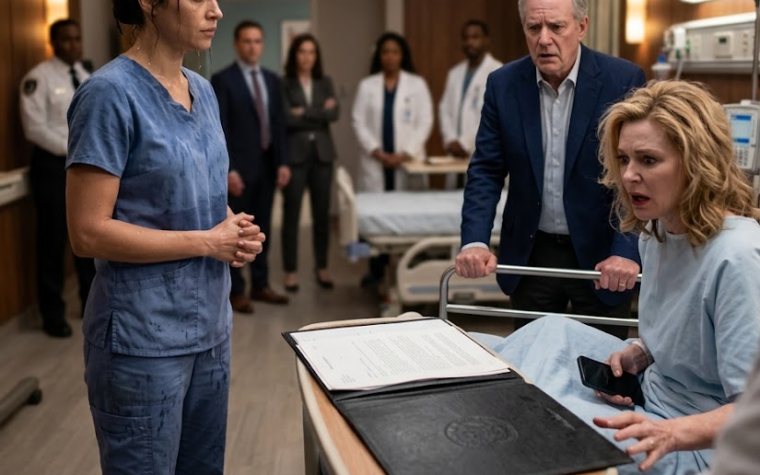
I opened the folder.
Nolan Voss turned the first page toward me, and for several seconds I simply stared at my own name.
The wet twenty-dollar bill lay beside my hand, leaving a dark stain on the marble table.
Brier said nothing.
She didn’t have to.
The documents in front of me were copies of emails, account inquiries, authorization requests, and notes documenting a series of calls my parents had made while I was unconscious or recovering from emergency surgery.
They had not spent those hours wondering whether I would be all right.
They had spent them trying to determine how much of my financial support they could protect if I stopped providing it willingly.
Nolan tapped the first page.
“This started the morning after your surgery.”
My father had contacted the financial institution connected to one of the household accounts I used to cover recurring expenses at their home.
He had described my hospitalization, explained that I was temporarily unavailable, and asked what authority he had to keep payments moving.
He had none beyond the limited access I had previously given him for household spending.
That answer apparently offended him.
So he kept calling.
There were notes from staff documenting his insistence that the house was effectively his, that the vehicle was for his use, and that certain expenses had always been paid by me and therefore should continue regardless of my condition.
My mother had made calls too.
Her concern was the cards.
She wanted to know whether her authorized spending would be interrupted if I remained hospitalized.
When told that the primary account holder retained control, she asked what would happen if I were unable to manage my own affairs.
I looked up at Nolan.
“How did you get this?”
“Through channels you already authorized Brier and me to monitor after the Lake Norman conversation,” he said.
“Remember the risk review?”
I did.
After Brier told me that money was the only soft thing in my parents’ house, I had done what I should have done years earlier.
I stopped treating my family finances like a private emotional problem and started treating them like exposure.
Nolan had helped me catalogue what I owned, what I paid, which accounts had authorized users, and which assets my parents merely occupied or used.
At the time, it had felt cold.
Sitting there with fresh surgical stitches and a twenty-dollar bill my mother had thrown into a puddle, it felt like the first intelligent thing I had done in years.
I turned another page.
There was the Tahoe.
Paid for by me.
Registered under arrangements I controlled.
Insured through payments that came from my accounts.
Then the house.
The country club property my parents called “our home” at dinners, fundraisers, and every social event where my mother wanted people to believe Graham Jenkins had somehow financed the life surrounding them.
My name sat at the center of the ownership structure.
They had lived there for years.
They had decorated it, entertained in it, complained about it, and spoken about it with the absolute confidence of people who had forgotten the difference between possession and ownership.
Nolan slid another document forward.
My father had asked a question about that too.
Not how to repair the broken stair railing.
Not whether I had legal recourse after falling from steps I had repeatedly warned him about.
He wanted to know whether the property could be transferred or refinanced while I was unavailable.
The answer had been no.
He had no authority.
But the question was enough.
Brier leaned back.
“You wanted a final look at their humanity,” she said quietly.
“You got one.”
I closed the folder.
The room was silent except for the low hum of the air conditioning.
My abdomen hurt every time I breathed deeply, but something inside me had become remarkably calm.
For years, my parents’ greatest advantage had been that I always responded emotionally.
They demanded, I explained.