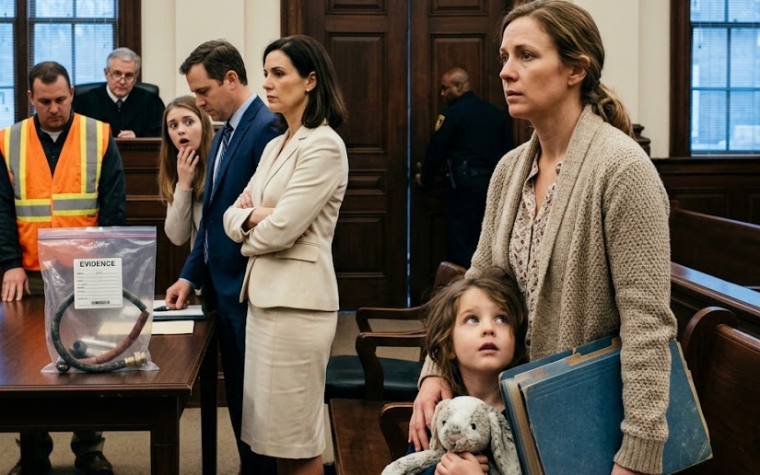
My mother immediately sat straighter.
For the first time, I understood what Nicole had done.
She had not merely convinced our parents to support her.
She had given them roles.
My mother would be the worried parent.
My father would be the disappointed father.
Chris would be the protective husband.
Nicole would be the wounded sister who only wanted what had supposedly been promised.
And I would be Tracy being Tracy.
Difficult.
Unreasonable.
Possessive.
Mr.
Bell called my mother first.
Susan Manning walked to the witness stand clutching her handbag until the bailiff asked her to leave it behind.
She swore to tell the truth and sat with her knees together, looking wounded before anyone had asked her a question.
“Mrs.
Manning,” Mr.
Bell said gently, “have you observed changes in Tracy’s behavior over the years?”
“Yes.”
My mother’s answer came quickly.
“What kind of changes?”
She looked toward me.
“She isolates herself.
She becomes very focused on money.
She doesn’t trust people.
Sometimes she’ll make a decision and refuse to discuss it.”
I almost admired the construction of it.
Working alone became isolation.
Managing investments became obsession with money.
Refusing to hand over my property became evidence that I couldn’t be reasoned with.
Mr.
Bell nodded sympathetically.
“Did you believe Tracy intended the mountain house to benefit the whole family?”
“Yes.
Absolutely.”
“Why?”
“Because family should share things like that.
Nicole has children.
Tracy doesn’t.”
Mr.
Johnson’s pen stopped moving.
Even Judge Brown looked up.
My mother realized too late what she had said.
Mr.
Bell moved quickly.
“But did Tracy discuss allowing Nicole’s family to use the home?”
“Yes.”
That part was true.
I had allowed them to stay there twice.
Once for a long weekend.
Once over Christmas.
I had even left groceries for them the first time.
Hospitality, apparently, had become a transfer of ownership.
When Mr.
Johnson stood for cross-examination, his manner stayed polite.