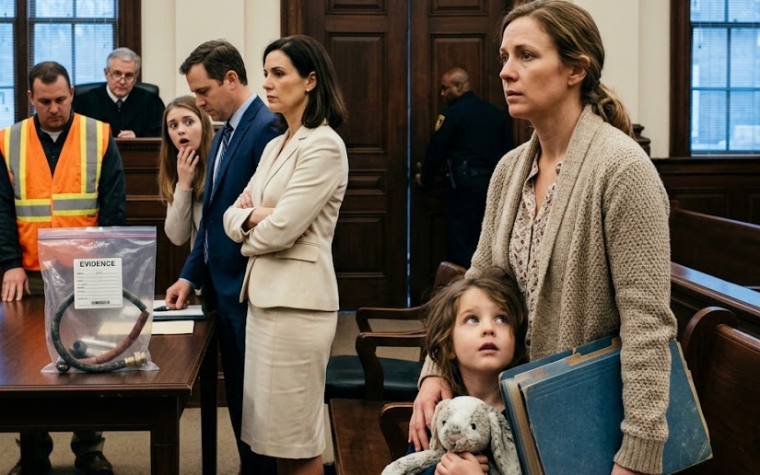
Patricia’s finger rested beside the first paragraph on page 47.
For several seconds, I couldn’t read it.
Not because the language was complicated.
Grandma’s lawyers had written the clause with unusual clarity.
I couldn’t read it because I suddenly understood why my father had gone pale.
Anderson Holdings LLC wasn’t a side account or a forgotten shell company.
It was the structure holding most of Grandma’s commercial real-estate interests and several of her largest long-term investments.
The trust owned the controlling membership interest.
Page 47 dealt with what happened to that control after her death.
I read the first sentence silently.
Then again.
Olivia finally snapped, “Well?”
Marcus gave her a warning look, but she ignored him.
“What does it say?”
I looked at Patricia.
She nodded once.
So I read aloud.
“Upon the death of Helen Anderson, sole voting authority attached to the trust’s controlling interest in Anderson Holdings LLC shall be exercised by the duly appointed chief trustee.”
Nobody spoke.
I continued.
The chief trustee alone held authority, subject to fiduciary duties and the trust documents, to approve or reject major asset sales, refinancing, changes in management, extraordinary distributions, and any attempt to liquidate the LLC’s holdings.
My father slowly leaned back.
That explained the color leaving his face.
The family hadn’t merely failed to inherit control directly.
Grandma had separated financial benefit from power.
My parents and Olivia would receive their annual distributions exactly as the trust required.
They would be comfortable.
They would be protected.
But they couldn’t sell the buildings because they wanted cash.
They couldn’t break apart the investment portfolio.
They couldn’t vote themselves into control.
And they couldn’t pressure me into approving an extraordinary distribution simply because they believed the money should belong to them now.
Marcus stared at the page.
“Is that the entire provision?”
Patricia’s expression didn’t change.
“No.”
That single word made Olivia sit down again.
I read the next section.
Grandma had anticipated disputes over the trustee’s authority.
Any beneficiary who believed I had breached my fiduciary duty could seek an independent review through the procedures established in the trust.
That was their protection against me.
But there was protection against them too.
No beneficiary, spouse, or representative could use professional influence, personal pressure, threats, or interference to circumvent the trustee’s lawful authority.
Any serious challenge had to be supported by evidence of misconduct, incapacity, or breach—not anger over the distribution structure.
While such a challenge was reviewed, discretionary distributions beyond the fixed annual amounts could be suspended.
The guaranteed distributions remained intact.
Grandma hadn’t written a revenge clause.
She had written a firewall.
And suddenly Marcus’s words near the conference-room door sounded very different.
Don’t worry.
We can fix this.
He heard it too.
I knew because he stopped looking at the paperwork and looked directly at Olivia.
“You need to be careful about what you say from this point forward.”
Her mouth fell open.
“You’re taking her side?”