I watched from behind the curtain but did not go outside.
Harrison gave him information for a temporary room and a counseling program.
Wyatt crumpled the paper in his fist.
“You’re choosing her over me,” he said.
Harrison shook his head.
“This is not a competition.
She needs safety.
You need accountability.”
Wyatt looked toward the house again.
“Does she hate me?”
“No,” Harrison said.
“That is why this took her so long.”
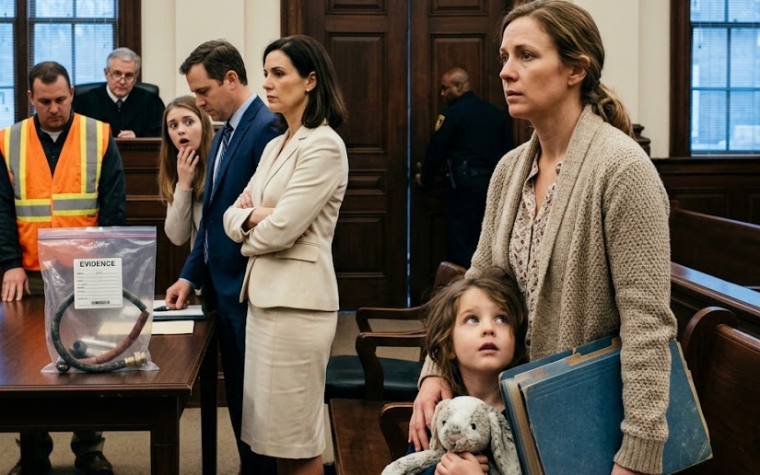
At the later hearing, Wyatt wore a clean shirt and kept his eyes lowered until it was his turn to speak.
He said he was ashamed.
Then he explained that he had been drinking, that he felt abandoned by his father and that I had always treated him like a failure.
The apology kept bending back toward blame.
When the judge asked whether I wished to speak, I stood with both hands against the table in front of me.
“I love my son,” I said.
“But I am afraid of the man he becomes when I tell him no.
I spent years protecting him from discomfort, and he learned to believe my fear was his authority.
I do not want revenge.
I want my home to be safe.”
The protective conditions were extended.
Wyatt was ordered to stay away from the house, attend counseling and comply with the requirements connected to the assault case.
There was no dramatic collapse.
No one applauded.
Wyatt simply sat down and stared at his hands as the consequences became real.
The first letter he sent through the approved channel arrived three weeks later.
It said he was sorry, but it also said Harrison had manipulated the situation and that I had embarrassed him by involving the police.
I placed the letter in the brown folder and did not answer.
The second letter came months later.
Its sentences were shorter.
Wyatt wrote that he had spent years turning every disappointment into proof that someone else had failed him.
He admitted he had used my love as protection from responsibility.
He did not ask to come home.
He did not ask for money.
He said he understood that forgiveness, if it ever came, would not erase the boundary.
I read that letter twice.
Then I put it beside the first one.
I was not ready to trust him, but for the first time, his apology did not demand that I rescue him from the discomfort of giving it.
Harrison returned to Denver after making me promise I would call before fear became an emergency again.
We did not rewrite our past.
We did not pretend his absence had not wounded Wyatt or exhausted me.
But we stopped allowing our guilt to excuse our son’s choices.
I returned to the school library the following week.
For several days, every slammed book made my shoulders tense.
I began speaking with a counselor and attended a support group where other women described the same confusion I had carried: the belief that being a good mother meant surviving whatever a child did to you.
Slowly, the house changed.
I repaired the damaged door.
I replaced the broken glasses.
I stopped keeping cash in the kitchen drawer.
I left Wyatt’s old room empty until I could enter without feeling that I owed the room an apology.
The embroidered tablecloth took longer.
The coffee stain never disappeared completely.
A pale brown shadow remained between two red flowers near the edge.
I could have thrown it away.