“Never for telling me something you think I should know.”
Her shoulders lowered a little.
That movement hurt more than the screaming had.
A six-year-old should not experience relief because an adult grants her permission to tell the truth.
The legal consequences did not arrive in one dramatic moment.
Real life rarely works that way.
There were interviews.
Reports.
Hearings.
Temporary orders.
Attorneys.
People using careful language around facts that looked brutally simple on video.
Vanessa fought the restrictions at first.
Her position was that I had weaponized a “private family incident” because of marital jealousy.
Her attorney emphasized my travel schedule.
Vanessa argued that she had been Emily’s primary day-to-day parent while my work repeatedly took me away.
That part was true.
I had been gone too often.
But distance was not the same as permission.
My attorney did not need to give a speech about my character.
He played the footage.
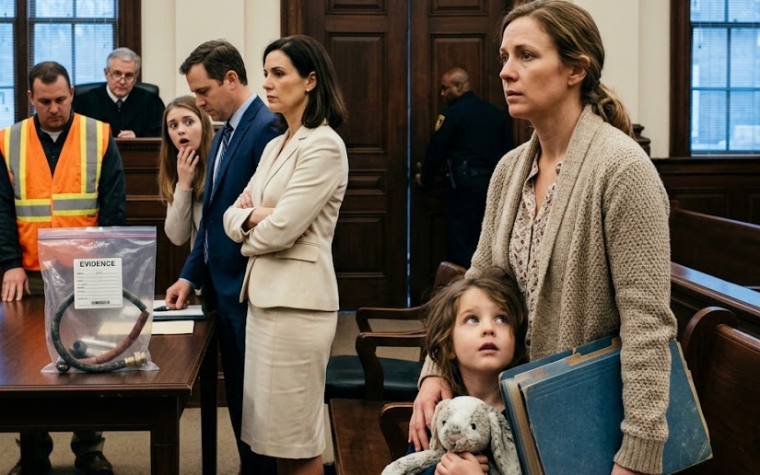
The courtroom became very quiet when Celeste’s voice came through the speakers.
“Scream for your daddy.
See if he comes.”
Vanessa stared at the table.
The judge asked one question after the video ended.
“Which adult in this recording is attempting to protect the child?”
Nobody on Vanessa’s side answered immediately.
That silence mattered.
So did Vanessa’s recording.
Once the relevant phone evidence was lawfully obtained and reviewed, it showed that she had not merely happened to be holding her phone.
She had deliberately filmed portions of the humiliation instead of intervening.
There was no heroic hidden context waiting outside the doorbell camera’s frame.
There was only a frightened child and adults who had convinced themselves that frightening her was justified.
Celeste continued to insist she had been trying to correct disrespectful behavior.
Her explanation collapsed under her own words.
People who are calmly correcting a child do not challenge that child to scream for an absent parent.
Miranda, Kelsey, and Brielle each tried to minimize their involvement.
Their accounts were evaluated individually, but the video prevented any of them from pretending the driveway scene had never happened.
The immediate result was that they lost unsupervised access to Emily while the case proceeded.
Vanessa’s access became subject to court restrictions and professional supervision.
The marriage ended separately.
I filed after the emergency hearing.
Vanessa accused me of planning it for months.
I hadn’t.
I had planned for facts.
There is a difference.
I had kept the camera backups because something felt wrong and because my daughter had started whispering into a lens when she wanted to tell me the truth.
I never imagined I would watch those backups in court.
Months later, when the major custody decisions were made, the court had more than one terrible afternoon to consider.
It had the preserved recordings, the conflicting statements, Emily’s professionally handled interviews, the pattern surrounding her calls, and the conduct of the adults after authorities became involved.
I received primary custody.
Vanessa was given a structured path toward contact under conditions designed around Emily’s safety rather than Vanessa’s pride.
Celeste was not permitted unsupervised contact.
The sisters discovered that being relatives did not entitle them to access a child who was afraid of them.
None of it felt like winning.