You sat outside my bedroom during the storm because you thought I was asleep and would never know.
You began bringing home the lemon cookies I liked without checking whether I had added them to the grocery list.”
I remembered every moment.
None had felt important at the time.
That was why they mattered.
I had stopped performing in those moments because I had forgotten to calculate what they might earn me.
“A person can begin with an ugly motive and still face a better choice,” Evelyn said.
“I could not decide which choice you would make.
I could only make sure fear was no longer making it for you.”
The niece wiped her face angrily.
“She should have confronted you.”
“She should have,” I said.
“And you should have told her.”
“I know.”
“Did you ever love her?”
It was the question I had avoided since the hospital.
I looked down at my wedding ring.
When I married Evelyn, I had not loved her.
During the first months, I had treated every kindness as a deposit toward the future I expected to collect.
But love had arrived quietly, without asking permission.
It had appeared in the way I automatically reached for her tea at the store.
In the fear that seized me when she coughed behind a closed door.
In the empty space beside me at night after the hospital took her away.
I had loved her before I knew I did.
I had simply recognized it too late to give her the honesty she deserved.
“Yes,” I said.
“But not when I should have.
And not honestly enough.”
Her niece studied me for a long time.
She did not forgive me.
I did not expect her to.
The final envelope contained a handwritten letter.
Unlike the recording, it was brief.
Evelyn wrote that the money used to clear my debts and pay for the program was not an inheritance.
It was the cost of giving me one unburdened year.
At the bottom, she had added one condition—not a legal condition, the lawyer explained, but a request.
When I could afford it, I was to buy a winter coat for someone who needed one and leave it where they could accept it without humiliation.
Her final sentence read, “What you truly wanted was never my money.
You wanted one safe place from which to become someone you did not have to be ashamed of.”
I read the sentence three times.
Then I covered my face with both hands.
I did not cry at the funeral.
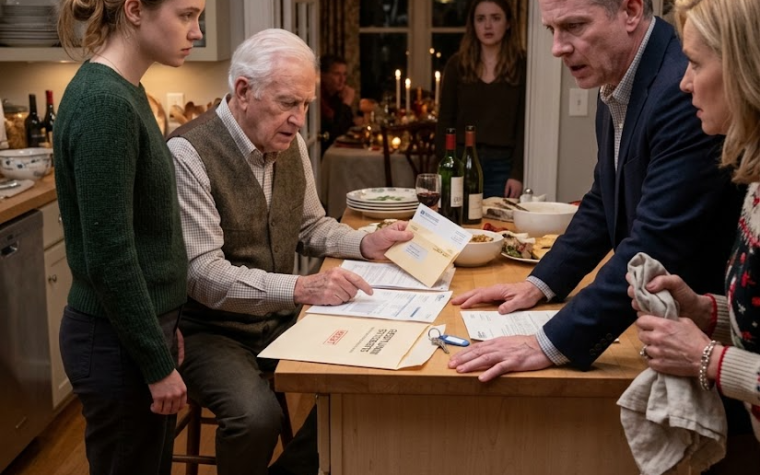
I cried in the lawyer’s office with Evelyn’s relatives watching, the brass key pressed into my palm and proof of my worst intentions spread across the table.
No one comforted me.
That felt right.
When the meeting ended, the niece gathered her copy of the will and stood near the door.
“You have thirty days to remove your belongings from the house,” she said.
“I can be out tonight.”
She looked surprised.
“You don’t have to be.”
“It’s your home now.”
The words hurt, but they were true.
Before leaving, I placed Evelyn’s jewelry box and the spare house key on the table.
Her niece glanced at my wedding ring.
“That was hers too.”
I curled my fingers around it.