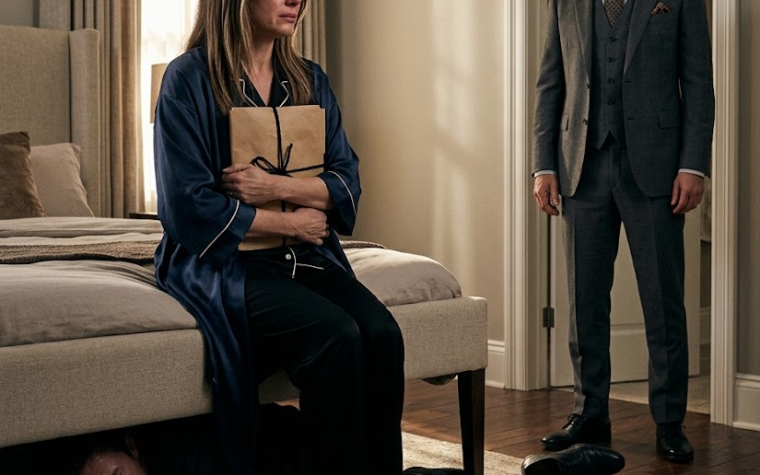
Charles looked smaller without the polished office, private driver, and executives waiting for his approval.
As he passed her, he whispered, “Everything you have still began with me.”
Ava met his eyes.
“No.
Everything I lost began with you.
What I built happened despite you.”
Eleven months after Nathaniel entered the conference room, Ava stood between two parallel bars in the Whitmore rehabilitation laboratory.
Her legs were supported by braces.
A therapist stood behind her, another at her side.
Hannah watched from the doorway.
Nathaniel and Sophia remained near the back, giving her space.
Ava pressed her palms down and shifted her weight forward.
Every muscle trembled.
For a moment, nothing happened.
Then her knees straightened.
She rose.
It was not graceful.
It was not effortless.
She could not release the bars, and she remained upright for only nine seconds.
But for the first time since she was nineteen, Ava Whitmore stood on her own feet.
When she lowered herself back into the chair, the room erupted.
Hannah covered her mouth.
Sophia cheered.
Nathaniel looked down, blinking hard.
Ava did not feel restored to the person she had been before the accident.
That young woman was gone, and no medical breakthrough could return twenty stolen years.
What she felt was ownership.
Not ownership of a company, a tower, or a block of shares.
Ownership of the truth.
Whitmore Access later created an independent patient-review program that funded second opinions for people given life-altering diagnoses.
The program’s rules prevented company executives, relatives, insurers, or donors from controlling medical decisions.
Nathaniel helped build its equipment-delivery network, making sure families received what doctors prescribed without delays hidden behind paperwork.
Sophia became one of the first children to use the expanded rehabilitation center, not as a favor, but through the same independent process offered to every applicant.
Ava continued using her wheelchair.
On good days, she walked short distances with braces and assistance.
On difficult days, her legs refused to cooperate at all.
She no longer measured dignity by whether she could stand.
She measured it by whether she was free to know the truth about her own body.
Months later, during another quarterly review on the thirty-ninth floor, Ava noticed a young courier waiting nervously beside the conference-room door with a document envelope.
An executive frowned at the interruption.
Ava raised one finger, and the room fell silent.
“Let him speak,” she said.
The courier stepped forward.
And this time, everyone listened.