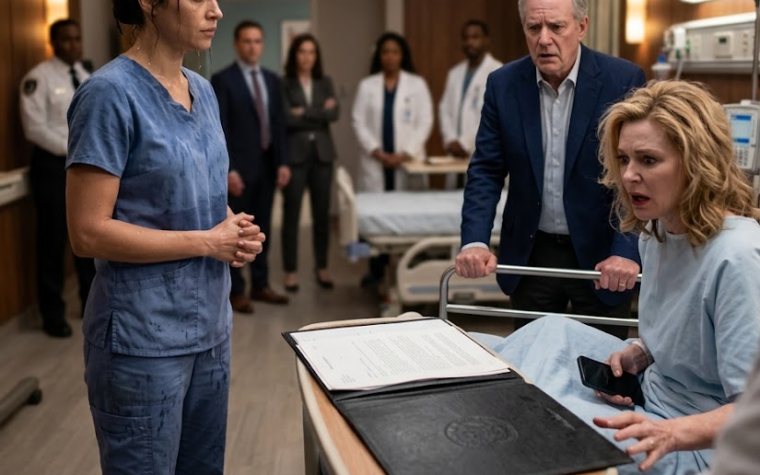
Dr.
Daniel Carter looked down at the first imaging report in Sarah Whitmore’s blue folder and read the sentence again before allowing himself to speak.
The delivery room had become so quiet that Sarah could hear the monitor behind her and the faint rattle of a cart moving somewhere beyond the closed door.
The older physician stood near Dr.
Carter’s shoulder.
“Daniel,” he said, “we need current imaging before—”
“No,” Sarah interrupted.
Her voice was tired, but steady.
For nine months she had done exactly what she was told.
She had arrived early.
She had taken her medications.
She had recorded her blood pressure.
She had signed forms she barely understood because every form carried the same precious word somewhere inside it.
Pregnancy.
She looked directly at Dr.
Carter.
“Read it.”
He did.
“Initial pelvic imaging: no definite intrauterine pregnancy visualized.
Large complex pelvic mass noted.
Urgent specialist evaluation recommended.”
Sarah’s fingers tightened around the yellow blanket resting beside her hospital bag.
Emily stared at the doctor as if she had misunderstood the language.
“A mass?”
The older physician stepped in quickly.
“That is an early report.
Early studies can be inconclusive.
We shouldn’t draw conclusions until—”
Dr.
Carter turned the page.
“There’s more.”
The older man’s face changed.
It was the smallest change—a tightening around the mouth, a sudden stillness—but Emily caught it immediately.
Dr.
Carter continued reading.
The report recommended an urgent gynecologic evaluation because the structure seen in Sarah’s pelvis did not resemble a normal early pregnancy.
Her blood work had shown elevated pregnancy hormone levels, but the radiologist had specifically warned that the laboratory result did not by itself prove there was a fetus.
Sarah looked from one doctor to the other.
“I was told I was pregnant that morning.”
Nobody disputed it.
She pointed weakly toward the stack of documents.
“I was told high risk.
I was told I could lose the baby.
I was told my age made everything dangerous.
You gave me prenatal appointments.”
Emily opened the folder wider and began pulling out records one by one.
“Here,” she said.
“Pregnancy follow-up.
Here—senior pregnancy monitoring.
Here—delivery planning.
What exactly was she supposed to think?”
The older physician tried again.
“Mrs.
Whitmore’s case was medically unusual.
There were positive hormone tests and symptoms consistent with pregnancy.”
Sarah stared at him.