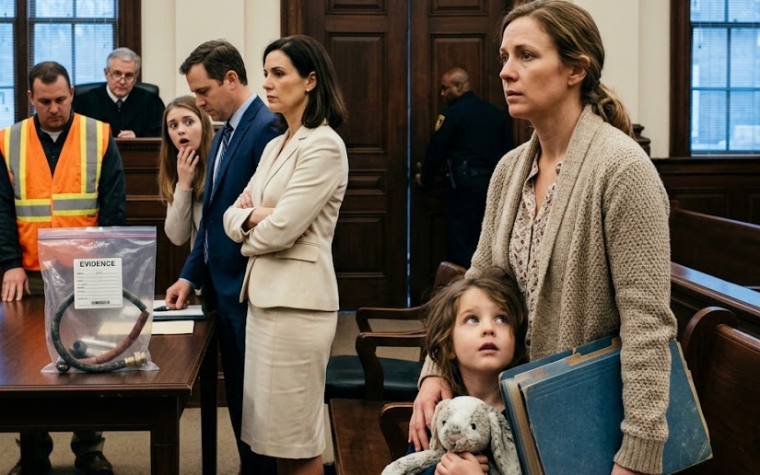
I opened the black folder as the front door swung inward.
Patterson Cole entered first, dressed in a charcoal overcoat and carrying a bottle of wine that probably cost more than Cynthia once claimed my entire wardrobe was worth.
His wife stepped in behind him, smiling until the cold air from the shattered dining-room window reached the foyer.
Then they saw the glass.
They saw the turkey lying on the patio.
They saw gravy staining my anniversary blouse.
And they saw their daughter standing beside Samuel with one hand pressed to her mouth.
Patterson slowly lowered the wine bottle.
“What happened here?”
Cynthia recovered first.
She always did when an audience arrived.
“She lost control,” she said, pointing at me.
“Samuel’s mother became violent because I made a small comment about dinner.”
“A small comment?” I asked.
Samuel stepped between us.
“Mom, please.
We can discuss this later.”
There it was again—the soft voice he used whenever he wanted my silence to protect him.
Patterson’s gaze moved from the broken window to the folder in my hands.
He recognized the embossed seal even though the lettering was too faint to read from where he stood.
“That looks like a Sterling Peak corporate portfolio,” he said.
Samuel’s face drained of color.
Cynthia looked at her father, then at me.
“Why would she have that?”
I placed the folder on the dining table, carefully avoiding the scattered pieces of glass.
“Because I founded Sterling Peak Holdings.”
The room went still.
Cynthia gave a short, disbelieving laugh.
“No, you didn’t.
Samuel founded it after his restaurant closed.”
Samuel’s eyes stayed on the floor.
Patterson noticed.
“Samuel?” he said.
My son swallowed.
“The structure is complicated.”
“It isn’t complicated,” I replied.
“You are the appointed manager.
I am the sole voting member and controlling owner.”
Cynthia turned toward him so quickly that one diamond earring caught the chandelier light.
“You told me the company was yours.”
“I run it.”
“That is not what I asked.”
Samuel rubbed the back of his neck.
“For practical purposes, it is mine.”
I removed the first document from the folder and laid it on the table.
The pages showed the formation of Sterling Peak Holdings, the capital contribution and the management agreement Samuel had signed six years earlier.
Patterson did not touch the papers.
He simply leaned close enough to study the signatures.
His expression hardened.
“You approached me for ten million dollars,” he said to Samuel, “while representing yourself as the company’s owner.”
“I never used that exact word.”
Patterson’s wife looked at him.
“At lunch, you called it your company at least five times.”
Cynthia shook her head.
“This is ridiculous.
She probably set up some meaningless parent company for tax reasons.