But stopping the men did not automatically erase the missed mortgage payments.
Carla explained that gently after the deputies left.
Robert sat in her office with Ethan beside him.
The excitement had faded, leaving him exhausted and deeply ashamed.
“I spent thirty-two years running into burning buildings,” he said.
“I thought I could recognize danger.”
“They did not approach you like danger,” Carla replied.
“They approached you like help.”
“I gave them almost everything I had set aside.”
“And you reported it as soon as you understood what happened.”
“My grandson reported it.”
Ethan leaned against Robert’s arm.
Carla contacted the bank’s fraud department, then the home-retention team.
She submitted Ethan’s note, Robert’s statement, the police report number, and copies of the false receipts.
The pending foreclosure review was placed on hold while the fraud investigation proceeded.
A hold was not forgiveness, and Carla refused to offer promises she could not keep.
She worked through the numbers with Robert instead.
His firefighter pension was enough to support the regular payment.
The crisis had begun because he believed the cash collectors were legitimate and gave them the money intended for the mortgage.
With the foreclosure paused, the bank could evaluate a repayment plan that spread the missed amount over time instead of demanding everything at once.
Robert signed the legitimate application inside Carla’s office, with every page explained before he touched the pen.
Three days later, the plan was approved.
The missed balance would be divided across future payments.
No one would arrive at night.
No one would empty the home.
No one would demand the deed at the kitchen table.
The house would remain Robert and Ethan’s home as long as Robert followed the new schedule.
When Carla gave them the news, Ethan immediately placed his coin-machine receipt on her desk.
“Use this for the first payment.”
Robert shook his head.
“You saved that money for two years.”
“I saved it for something important.”
“You are important.”
“So are you.”
Robert looked at Carla as if hoping she would settle the argument.
She slid the receipt back between them.
“The money belongs to Ethan.
The decision should belong to him, too.”
Robert wiped his eyes with the heel of his hand.
Finally, he agreed to use part of Ethan’s savings toward the first payment under the new plan.
He promised to replace every dollar.
Ethan made him promise something else as well.
“No more hiding grown-up problems.”
Robert nodded.
“No more hiding.”
The investigation continued for months.
The two men were charged after authorities connected the forged papers and counterfeit identification cards to several attempted property scams.
Other homeowners came forward after learning what had happened at First Community Bank.
Some had lost cash.
Others had nearly signed away their homes.
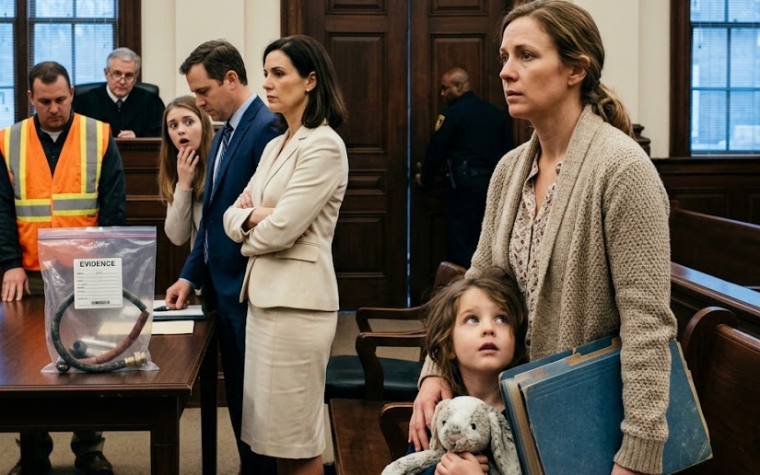
Robert testified about the envelopes, the threats, and the shame that had kept him silent.
He did not enjoy speaking in front of strangers, but Ethan sat behind him during every hearing.
Whenever Robert’s voice faltered, he looked at the boy and continued.
First Community Bank added warnings to mortgage notices explaining that employees would never arrive unannounced to collect cash or demand property documents.
Carla also began calling older customers personally when accounts became delinquent, not to frighten them, but to make sure no stranger reached them first.
Robert never missed another payment.