Imaging showed no fractures or internal injury, but the doctors documented extensive soft-tissue bruising and the dangerous delay in treatment.
A child-protection investigator met me at the hospital.
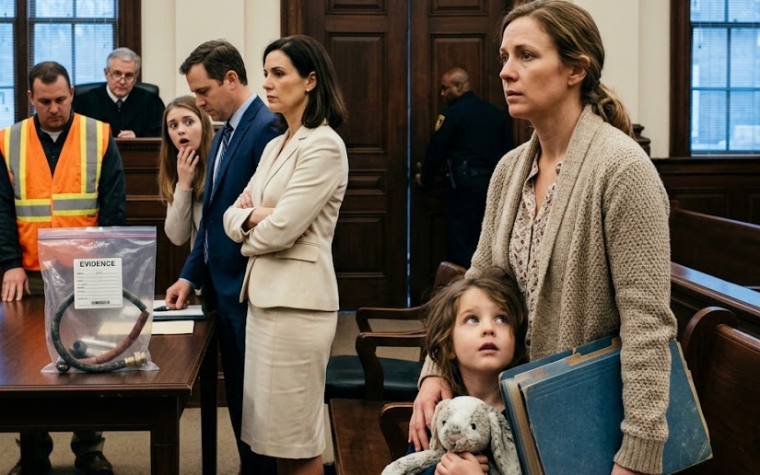
With the recordings and police report, the family court issued an emergency order preventing Michael from contacting Emma.
I was granted temporary sole custody before we left the hospital.
The legal process did not feel triumphant.
It felt like signing my name while standing in the ashes of a house I had once called safe.
Michael’s attorney initially claimed the videos had been misunderstood.
Then investigators recovered more archived clips directly from the camera company.
The original files included timestamps and device records that had not been altered.
His attorney changed strategies.
Michael began saying he had been under extraordinary work pressure.
He claimed I had left him unprepared to care for a toddler.
He blamed Emma’s crying, our marriage, his job, and even the camera.
He blamed everything except his own hands.
The nurse cooperated with investigators.
Her messages established that Michael had been planning to leave the house that afternoon despite Emma’s fever.
In one exchange, she had asked why he could not bring the child to another caregiver.
He replied that the child was not his problem for much longer.
That message did not prove physical abuse, but it revealed the cold calculation behind his neglect.
He had not lost control for one terrible second.
He had chosen, repeatedly, to treat Emma’s pain as an obstacle.
Months later, the criminal case ended with convictions for child endangerment and assault.
The court imposed penalties, required a long intervention program, and prohibited unsupervised contact with Emma.
In the divorce, the recordings and medical evidence prevented him from presenting himself as the misunderstood parent he wanted the court to see.
I received sole physical custody.
Any future request for contact would require professional review and proof that contact could occur safely.
Michael’s accounting firm terminated him after learning that he had used a client-connected apartment to conceal his affair and had lied during the investigation.
The nurse ended all contact with him.
She sent me one letter through the prosecutor’s office, apologizing for the part she had unknowingly played in his deception.
I never answered it.
Not because I hated her, but because healing did not require me to take care of every person he had hurt.
The first weeks at home were quiet in a new way.
Emma startled when a man raised his voice on television.
She cried whenever I walked toward the front door with my work bag.
For a while, I took leave from school.
Mrs.
Teresa brought soup, folded laundry, and sat with Emma while I spoke to attorneys and counselors.
We removed the security camera from above the bookcase after copies of every file had been preserved.
For days, a pale rectangle remained on the wall where the camera had blocked the sunlight.
Emma pointed at it once.
“Camera gone?”
“Yes.”
“Daddy gone?”
I knelt so we were eye level.
“Daddy cannot hurt you here.”
She touched my cheek with her small hand.
“Mama home.”
“Yes,” I said.
“Mama’s home.”
Therapy helped her put simple words to feelings she had carried in her body.
Scared.
Hurt.
Loud.
Safe.
The counselor taught me not to question her in ways that might shape her memories.
Instead, I learned to listen when she spoke and to believe the truths she could express.