A doctor documented the finger-shaped bruises on Lily’s shoulder.
Anna had injuries consistent with being dragged and confined.
The continuous recording preserved Dean’s threats, his admission that he had taken Anna’s money, and the moment he discovered Lily had escaped.
The evidence left him little room to reshape the story.
Still, he tried.
From jail, Dean contacted acquaintances and claimed Anna had manipulated the bikers into attacking him.
That version collapsed when records showed the bikers had remained at the tavern until police arrived and that Stone had followed every instruction the officers gave him.
Dean then claimed the recording captured only one bad argument.
Investigators recovered additional messages from Anna’s phone: apologies followed by threats, promises to change followed by demands that she surrender her wages, and warnings that he would portray her as an unfit mother if she ever left.
Anna had preserved them quietly for months.
She had not stayed because she believed Dean.
She had stayed because every attempt to leave had been watched.
Dean checked the car mileage, searched her purse, and demanded receipts for groceries.
The envelope he found behind the drawer contained enough money for two bus tickets and one night in a motel.
When he discovered it, he understood that Anna was preparing to escape.
That was why the violence escalated.
What Dean mistook for surrender had actually been planning.
Anna had charged the old phone in secret.
She had cleared space for a long recording.
When Dean began shouting that night, she pressed the button, slipped the phone into Lily’s coat lining, and created the only opening she could.
The instruction to stay quiet was never a demand to hide the truth.
It was a mother asking her daughter to move silently past a dangerous man.
In the weeks that followed, Anna and Lily moved into temporary protected housing.
The Iron Horses did not demand details or photographs.
They delivered groceries, replaced Lily’s ruined sneakers, and arranged for Anna’s belongings to be collected from the house under official supervision.
Stone refused to let the club turn the rescue into a performance.
“She came to us because she needed help,” he told the others.
“Not because she wanted to become a story people used to make themselves look good.”
Ryder understood.
He still struggled with the memory of Lily exposing the bruises, but he learned that protection was not always loud.
Sometimes it meant sitting through an interview.
Sometimes it meant driving behind a police car instead of ahead of it.
Sometimes it meant keeping your temper so a frightened child’s evidence remained stronger than an abuser’s lies.
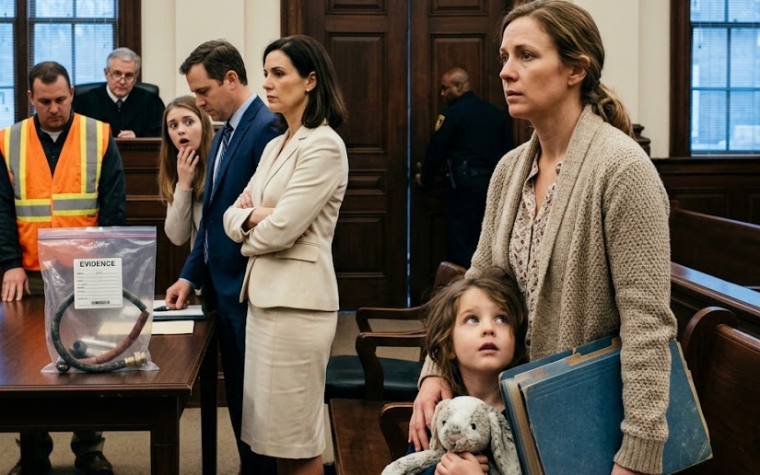
At the preliminary hearing, Dean entered the courtroom with the same confidence he had shown on the porch.
His attorney questioned whether the recording captured the entire context.
Then prosecutors played it from the beginning.
The courtroom heard Anna telling Dean to leave Lily alone.
It heard Lily cry.
It heard Dean threaten them both.
It heard the cellar lock and Anna whispering her escape instructions into the coat.
Dean stared at the table.
His confidence did not survive his own voice.
Faced with the recording, the documented injuries, the outside lock, the key found in his pocket, and the statements he had made to police, Dean eventually pleaded guilty to charges connected to the assault, child abuse, threats, and unlawful confinement.
He received a prison sentence and a no-contact order barring him from approaching Anna or Lily.
The legal outcome did not erase what happened.
Lily still woke at sudden noises.
Anna still checked every lock twice.
For months, both of them fell silent whenever a truck slowed outside.
But silence no longer belonged to Dean.
Anna found work in a nearby town.
She opened a bank account only she controlled.
She and Lily moved into a small apartment with bright windows and a door that locked from the inside.
One afternoon, several months after the night at the tavern, the brass bell above the Iron Horses door rang again.
Every biker in the room looked up.
Lily stood in the doorway wearing a blue coat that fit her properly.
Her copper hair had been brushed into two loose braids.