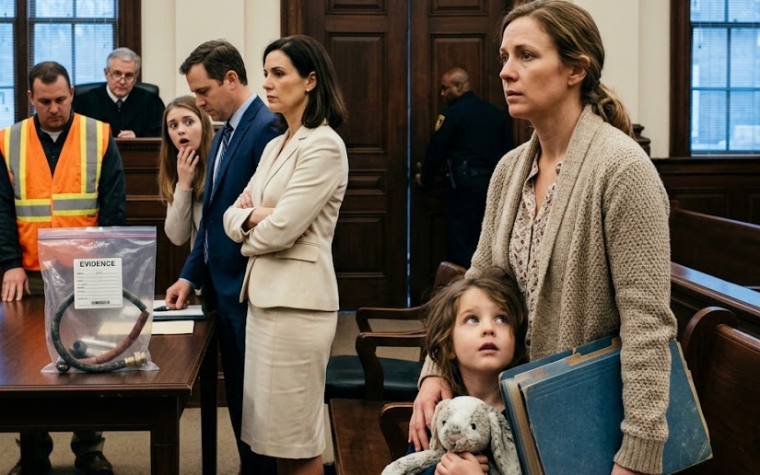
“You said you hadn’t contacted anyone.”
“You wrote the letter.”
“I told you not to send anything.”
“You said pressure would work.”
Their alliance lasted exactly as long as their belief that I would remain silent.
Dad raised both hands.
“This family is not going to be torn apart over one bad dinner.”
I looked at him.
“It was not one dinner.”
He opened his mouth, but I continued.
“It was every joke about my education.
Every time you called my work a phase.
Every bill you accepted while pretending I was a failure.
Every holiday when you praised Ryan and Brooke, then asked whether I had found a real job.
The dinner was only the first time I stopped protecting you from the consequences.”
Mom began to cry.
Quietly, of course.
Even her grief had learned not to disturb him.
Dad turned toward her.
“Helen, please.”
She pulled away from his hand.
Then she looked at me.
“I knew about the surgery money,” she said.
“I should have called you.”
I waited.
“I was ashamed,” she continued.
“Not because you paid it.
Because I had let your father speak about you that way after I knew.”
It was the first honest thing anyone in my family had said to me in years.
It did not repair the damage.
But it was honest.
The legal resolution took two more weeks.
My parents and siblings withdrew every demand.
They signed a statement confirming that the assistance I had provided was voluntary, that I had never requested control over their property or decisions, and that their accusations of financial coercion were unsupported.
They agreed not to contact my employees, investors, vendors, or business partners.
They reimbursed the legal fees caused by Brooke’s letter and Ryan’s emails.
Brooke’s firm opened an internal investigation after learning she had used its letterhead for a personal family dispute without authorization.
She was removed from client-facing work during the review and required to report the matter to the firm’s ethics committee.
She did not lose her license, but the polished certainty she had worn like armor finally cracked.
Ryan’s bank disciplined him for using company systems to pursue a private campaign and for attempting to obtain information connected to my earlier title-company transfer.
The promotion he had been expecting went to someone else.
Dad did not lose his house because of me.
He lost the fantasy that I would always protect it.
The retirement package was never activated.
The medical reserve was withdrawn before acceptance.
I left every past payment exactly where it was and asked for nothing back.
For the first time, my parents had to build a future using only the money they had earned and saved themselves.
Dad called that abandonment.
I called it accuracy.
Mom wrote to me twice after the settlement.
The first letter was full of explanations—how difficult Dad could be, how she had tried to keep peace, how family roles became habits before anyone noticed.
I returned it unanswered.
The second letter was different.
It contained no excuses.
She wrote that silence had been her way of choosing the person causing harm while pretending she had chosen no one.
She said she understood that an apology did not create access to me.