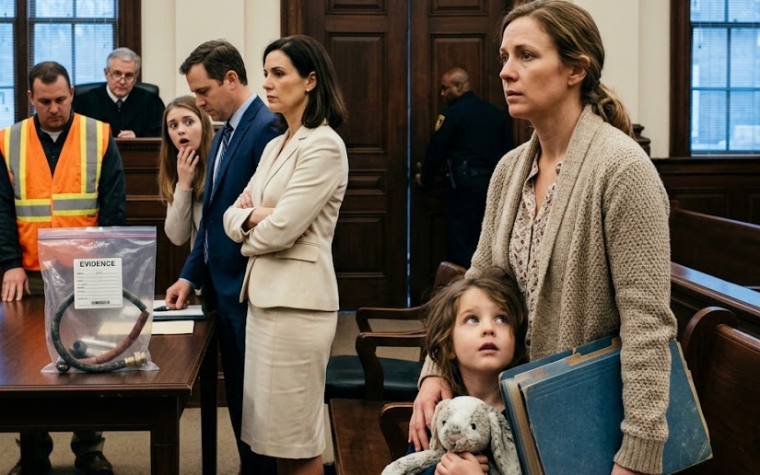
My attorney opened the folder slowly enough that Trevor had time to recognize the first page.
I saw the exact moment he did.
His shoulders tightened.
The relaxed expression he had worn through the first part of the hearing vanished, and for the first time since he had walked into the kitchen at 4:30 that morning and said “Divorce,” he looked directly at me as though he were finally seeing the person sitting across from him.
My lawyer placed a copied bank statement on the table.
“Mr.
Hayes,” she said, “before we continue, I think the court needs to ask why these figures do not match the financial information you provided.”
Trevor’s attorney leaned toward him immediately.
Behind Trevor, Diane Hayes stopped moving.
Until that moment, the Hayes family had treated the divorce like another problem they could manage with the right clothes, the right lawyer and the right version of events.
Trevor was the hardworking husband from a respected Scottsdale family.
I was the wife who had lived in his parents’ home, stayed out of the workforce and then abruptly left carrying our infant son.
It was a neat story.
It was also incomplete.
My attorney lifted another page.
The records I had collected were not secret documents stolen from a locked office.
They were statements, receipts and household financial papers I had been able to see while I lived in the home, along with photographs I had taken before certain statements stopped arriving and before passwords to accounts I had previously seen were changed.
On their own, my copies were clues.
Once I hired an attorney, those clues gave her specific accounts, dates and transactions to pursue through the proper legal process.
The official records that came back confirmed what I had noticed months earlier.
Money connected to our married life had not simply disappeared.
It had moved.
Again and again.
Some transfers occurred shortly after I became pregnant.
Others appeared during the final months before Trevor asked for the divorce.
Individually, many were easy to dismiss as ordinary family financial activity.
Together, they formed a pattern.
And the amounts reflected in the records did not line up cleanly with the simplified financial picture Trevor had presented during the divorce proceedings.
Trevor’s attorney stood.
“There may be explanations for transfers involving extended family accounts.”
My lawyer nodded.
“That is precisely why we are asking for complete disclosure.”
Trevor whispered something to his attorney.
Diane leaned forward from the bench behind him.
It was the first time I had ever seen her look uncertain inside a room she could not control.
For three years, uncertainty had belonged to me.
I remembered my first months at the Hayes estate, when Trevor told me living there was temporary.
“Just until our house is ready,” he had said.
I believed him because I wanted to.
I had given up the rhythms of my old working life believing I was building something with my husband.
Then the months stretched into years, and the house slowly reorganized itself around my availability.
At first Diane asked whether I minded helping with dinner.
Then she asked whether I could prepare a guest room.
Then she stopped asking.
There was always another breakfast, another dinner, another visitor, another set of linens.
When I was pregnant, I cooked with aching feet because everyone else was busy.
After our son was born, I learned to make coffee while holding him against my shoulder.
Trevor called that arrangement practical.
Diane called it helping the family.
I had started calling it normal because admitting otherwise frightened me.
But the accountant in me never disappeared completely.
The first thing that bothered me was not a dramatic discovery.
It was an absence.
A bank statement that normally arrived did not.
Then another.
When I casually asked Trevor whether the statements had gone paperless, he answered too quickly.