Her mother took another breath.
“I kept thinking if I could keep him calm, I could keep us safe.
But I was making you live around his anger.
I should have protected you.”
My granddaughter stared at her for a long time.
“When he said I fell, you looked right at me.”
“I know.”
“And you didn’t say anything.”
“I know.”
My daughter began to step closer, then stopped herself.
“I won’t ask you to forgive me tonight.”
That was the first useful thing she had said.
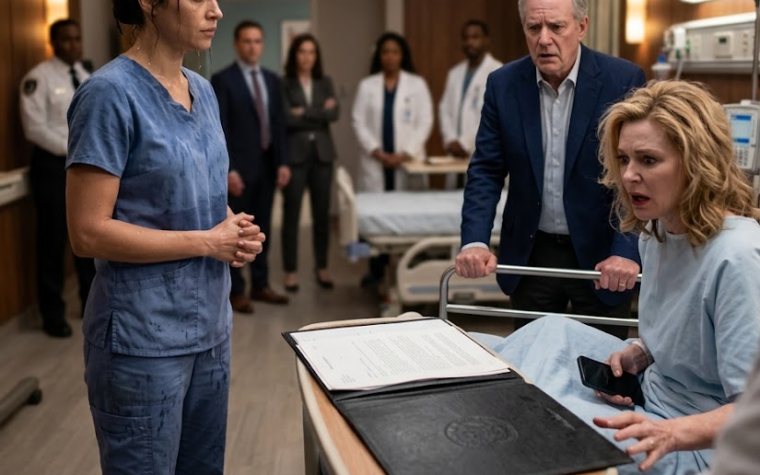
Around dawn, two officers arrived to take preliminary information.
They spoke first with hospital staff, then separately with my granddaughter.
The orthopedic surgeon documented the medical findings carefully.
The social worker remained involved.
Security kept the adults separated so no one could pressure my granddaughter into changing her account.
Her stepfather continued insisting the injury came from a fall.
Then he began changing details.
First she had slipped near the stairs.
Then he said she had fallen in her bedroom.
Then he claimed he had not actually seen the fall at all, only heard it.
Each revision seemed small to him.
Together, they mattered.
He demanded to know why everyone was treating him like a criminal.
He accused me of turning my granddaughter against him.
He accused the hospital of overreacting.
He accused my daughter of being weak when she refused to repeat his version again.
That last accusation ended whatever hesitation remained in her.
“Stop,” my daughter said.
I was standing beside her when she said it.
Her husband stared at her as though the word itself were a betrayal.
“What did you say?”
“I said stop.”
He stepped toward her.
Security immediately moved between them.
My daughter did not retreat.
“She’s not going home with you.”
His face changed completely then.
The smug impatience disappeared.
For the first time, he understood that the family structure he had relied on—my granddaughter’s fear, my daughter’s silence, everyone’s instinct to avoid a scene—was collapsing in public.
He looked at me.
“You did this.”
“No,” I said.
“She called for help.”
That distinction mattered more than he understood.
I had not created the truth.
The surgeon had not created it.
The scan had not created it.
My granddaughter had simply reached a place where the truth could no longer be contained inside the house.
The officers separated him from us while they continued their investigation.
By the time the sun was coming up, arrangements were being made so my granddaughter would not have to return to the home with him.
My daughter agreed to cooperate with the safety plan and told the social worker she would stay elsewhere as well.
There were no miraculous repairs that morning.
My granddaughter did not suddenly trust her mother again.
My daughter did not become brave enough to erase months of silence simply because she finally spoke.