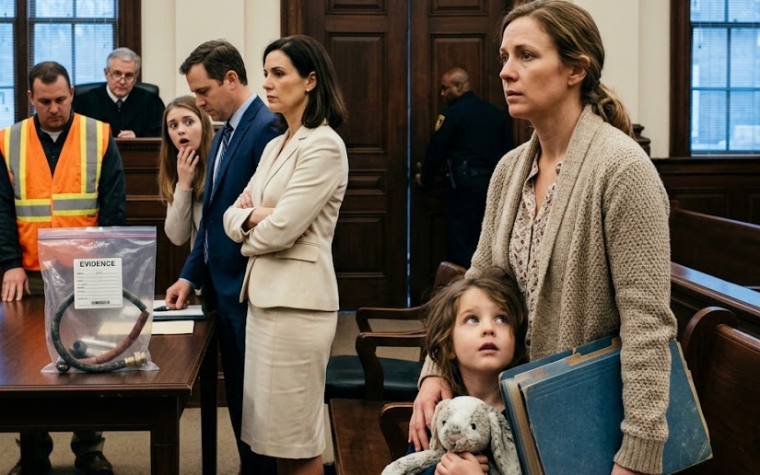
And I did not feel triumphant.
I felt furious, relieved, guilty and grateful in alternating waves.
I wondered whether I should have confronted my daughter months earlier when I noticed the long sleeves.
I wondered whether I should have asked harder questions.
I wondered how many clues a physician can recognize in strangers while still hoping not to recognize them in her own family.
But one thing I did not regret was giving that girl a private way to reach me.
Over the days that followed, the medical documentation, her statements and the accounts gathered by investigators became part of a formal case.
Her stepfather was kept away from her while the legal process moved forward.
Protective restrictions were put in place.
What happened next belonged to courts, investigators and advocates trained to handle what our family had failed to handle privately.
My granddaughter stayed with me.
The first night, she slept nearly twelve hours.
The second night, she woke when a car door slammed outside.
By the third week, she had stopped asking whether I was sure she could remain.
Her arm healed more quickly than the rest of her.
Trust was slower.
Her mother visited only when my granddaughter agreed.
Sometimes they spoke for an hour.
Sometimes five minutes.
Once my granddaughter refused to see her at all, and my daughter sat in her car outside for twenty minutes before leaving.
I did not force reconciliation.
Love without accountability had already caused enough damage.
Months later, my granddaughter sat at the same kitchen table where I had once slid the secret phone toward her.
It was warm outside again.
This time she wore a short-sleeved shirt.
Her healed arm rested on the table beside a glass of lemonade.
The extra phone lay between us.
“Do you want this back?” she asked.
I looked at it.
“Do you still need it?”
She considered the question.
Then she pushed it toward me.
“I don’t think I need a secret one anymore.”
That was when I finally cried.
Not because everything had been fixed.
It hadn’t.
There were still appointments, legal proceedings, difficult conversations and nights when fear arrived without warning.
Her relationship with her mother had become something they were rebuilding carefully rather than pretending had never broken.
But the secrecy was gone.
The story that had protected the person causing the fear was gone.
And the girl who once believed she had to endure everything quietly now knew what happened when she used her own voice.
At 3:17 that morning, she had called me because she thought she needed one person to believe her.
By sunrise, she had doctors, nurses, a social worker, investigators and finally her mother refusing to look away.
People often imagine that a family truth comes out in one dramatic confession.
Ours didn’t.
It came out through a hidden phone line, a splinted arm, an old injury on a scan, a frightened sixteen-year-old answering one careful question at a time, and a surgeon who understood that the most important thing in the room was not the story the adults had brought with them.
It was the child who finally had the chance to tell her own.