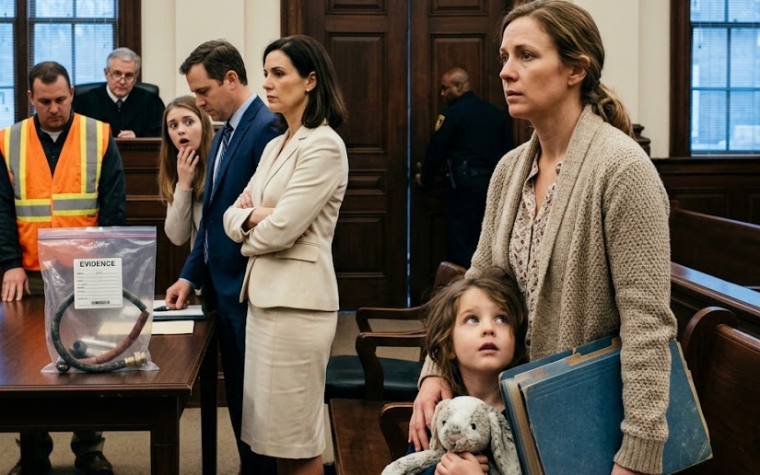
She asked the court to remember that the driver had been afraid of losing his future, while Elias had lost every future moment with his daughter.
The judge imposed a prison sentence and ordered restitution, though no sentence could replace what had been taken.
The neighbors faced no criminal charges.
Failing to knock, answer a door, or recognize a child’s distress was not enough for prosecution under the circumstances.
But the absence of criminal guilt did not free them from consequence.
Their own recordings became evidence of their choices.
The woman across the street moved away before winter.
The man who ignored Harper resigned from the neighborhood association after residents demanded it.
Others began attending community meetings they once dismissed as pointless.
They created an emergency contact network for children, older residents, and people living alone.
Local families placed small blue lights inside front windows to show that a child could knock there for help.
Volunteers stocked a pantry at the elementary school with food, hygiene supplies, and electrolyte drinks.
They named it after Elias.
Sarah agreed to the name only after Harper’s aunt approved.
“People shouldn’t get to turn him into a symbol and forget he was a person,” she said.
So the pantry wall displayed no dramatic slogan.
It held one framed copy of Elias’s shopping list, with personal medical information covered and the tiny star still visible.
Beneath it was a simple sentence chosen by Harper:
“He was coming home.”
At Elias’s funeral, Harper wore a purple ribbon in her hair.
She carried a fresh bottle of grape electrolyte drink to the front of the chapel and placed it beside his photograph.
Marcus attended in the back row.
He had never met Harper face-to-face, but she recognized his voice when Sarah introduced them.
“You’re the phone man,” Harper said.
Marcus knelt.
“I’m Marcus.”
“You believed me.”
“Yes.”
“Even when I whispered?”
“Especially then.”
Harper considered that answer and slipped her hand into her aunt’s.
After the service, Sarah gave Harper a sealed plastic sleeve containing a clean photocopy of the shopping list.
The original remained evidence until the case concluded.
Harper traced the star beside her name.
“Daddy drew stars when something was important,” she said.
“You were the important part,” Sarah replied.
Nearly a year later, Harper was living with her aunt and attending a new school.
Her arm had healed, leaving only a faint mark.
She still became anxious when adults left without stating exactly when they would return.
Her aunt learned to write departure and return times on a small board near the door.
Every promise was specific.
Every delay came with a phone call.
On the anniversary of the 911 call, Harper visited the Elmbridge pantry with Sarah and Marcus.
The shelves were full.
A volunteer placed a new box of crackers within reach of small hands.
Harper stood before the framed list.
For a long moment, she said nothing.
Then she looked at Marcus.
“Daddy said love can hurt because medicine stings.”
Marcus nodded.
Harper touched the tiny star through the glass.
“But love is also when somebody comes because you called.”
Sarah felt the words settle over the room.
Elias had tried to return with rice, broth, antibiotics, and the purple drink his daughter loved.
A speeding driver had stopped him.
A street full of witnesses had failed her.