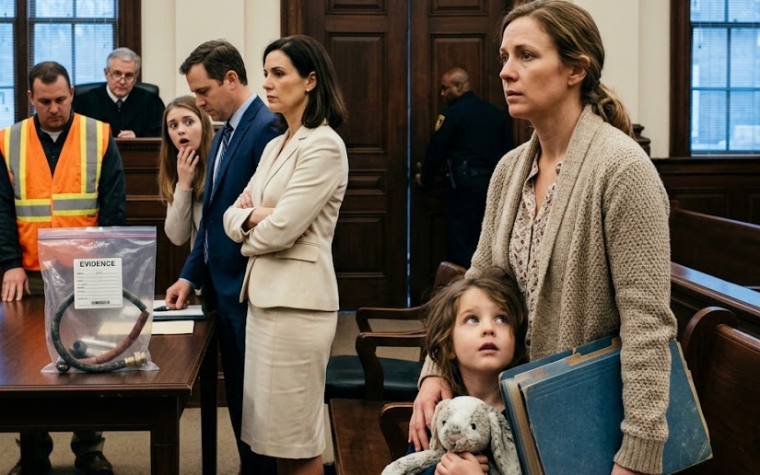
They found me in the waiting area with the envelope held against my chest.
Daniel knelt in front of my chair.
“Why didn’t you tell us how bad things were?”
“Because you have your own families.”
“You are our family.”
I looked away because that kindness hurt more than Richard’s cruelty.
Emily sat beside me and took my hand.
When she saw the tape inside my shoes, she began to cry.
I had spent five years hiding my hunger to avoid becoming a burden.
Richard had spent five years relying on that silence.
The following day, we met a solicitor recommended by a local advice centre.
She read the bank documents, the divorce order and the letters from the envelope without interrupting.
Then she asked me to describe exactly what Richard had said in the court corridor.
When I finished, she placed her pen on the desk.
“The money in this account is unquestionably yours,” she said.
“But there is another issue.”
She pointed to a paragraph near the back of the pension schedule.
Richard had been required to transfer a percentage of his private pension into a separate plan in my name within four months of the divorce.
The £54,000 in the bank account was only an interim equalisation payment.
It did not replace the pension-sharing order.
According to the paperwork, the full transfer had never been completed.
The solicitor requested records from the pension provider.
Two weeks later, they confirmed that Richard had repeatedly delayed the process by failing to submit final identification documents.
For five years, he had complied just enough to avoid immediate scrutiny while allowing me to believe I had received everything.
The solicitor applied to the family court for enforcement.
Richard responded with a letter claiming I had understood the arrangement and voluntarily chosen not to access the account.
He suggested that age and illness had confused my memory.
That argument lasted until the bank produced his signed mandate and the recording of our telephone call from the manager’s office.
He had not known the bank recorded calls made on its internal line.
His own voice became the clearest witness against him.
You were never good with money.
I assumed you would spend the three thousand and close the account.
At the hearing, Richard sat at the opposite table in a dark suit, surrounded by neatly stacked papers.
He looked older, but he still wore the expression that had once made me doubt my own understanding before he said a word.
The judge asked why the pension transfer had not been completed.
Richard blamed the provider.
The provider’s records showed six unanswered requests sent to him.
He blamed his former solicitor.
His former solicitor produced copies of letters warning him that failure to cooperate could result in enforcement costs.
Finally, he said he believed the bank payments had been sufficient.
The judge read aloud the paragraph stating that they were separate obligations.
Richard’s certainty began to collapse.
I did not interrupt.
I did not accuse him of ruining my life.
I sat with my hands folded beside the envelope and allowed each document to do what I had never been able to do during our marriage: finish speaking without being talked over.
The court ordered the pension share to be transferred immediately, with compensation for the lost growth.
Richard was also required to pay the enforcement costs caused by his delay.
The judge did not send him to prison.
There was no dramatic arrest or shouted confession.
The consequence was quieter and, to Richard, perhaps worse.
The record now described his conduct plainly.
He had withheld information from a financially vulnerable former spouse.
He had failed to complete an order.
He had attempted to portray legal entitlement as personal generosity.
Outside the courtroom, we stood in almost the same corridor where he had given me the card five years earlier.
The smell of burnt coffee and damp coats was unchanged.