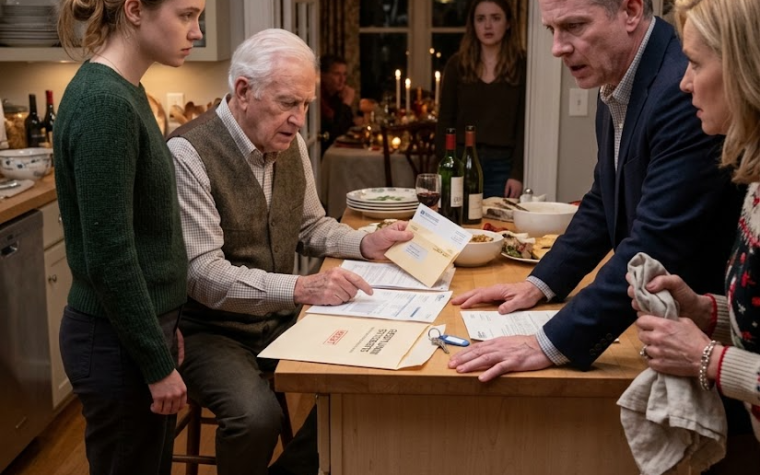
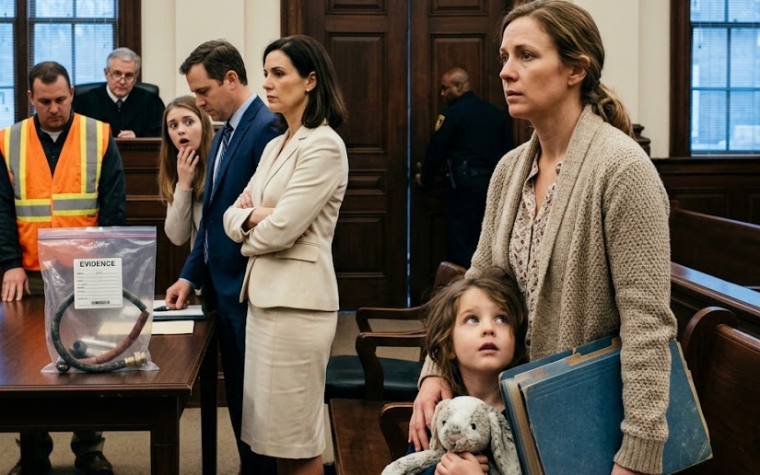
My father’s face went pale before the court officer said a single word.
I watched through the security feed on my phone from my friend’s kitchen table, still wearing the clothes I had left the party in.
My cheek was no longer burning, but when I touched it, the skin was tender.
On-screen, my grandmother’s attorney, Martin Hale, stood at the bottom of the mansion steps with the same dark leather folder he had carried into our first meeting six months earlier.
My father, Victor, stared at the document the officer had handed him.
“What is this?” he demanded.
Martin’s voice was calm.
“An enforcement order and notice appointing a receiver over the estate property and the family holding company.”
Celeste appeared behind my father in a silk robe.
“What does that mean?”
My father ignored her.
“You can’t seize my house.”
Martin looked at him for a moment.
Then he said, “It isn’t your house.”
Even through the tiny speaker on my phone, the silence afterward felt enormous.
Six months earlier, I hadn’t understood those words either.
When Martin first called me, I assumed he wanted to discuss some forgotten personal item from my grandmother’s estate.
She had been dead nearly three years.
My father had handled everything after the funeral, or at least he had told us he had.
Grandmother Evelyn had built most of what our relatives called “the family fortune.” The vineyard had belonged to her parents.
She expanded it, bought neighboring land, built the events business, and eventually turned a modest agricultural company into a group of profitable properties.
My father loved telling people he had inherited her empire.
Apparently, that wasn’t what she had done.
Martin had shown me the trust papers in his office.
My grandmother had divided control from occupancy.
My father had been allowed to live in the mansion and manage portions of the company, but ownership of the controlling interest had passed into a trust.
I was the principal beneficiary, and when I finished my second year of law school, certain voting and enforcement rights transferred to me.
My grandmother had anticipated conflict.
Martin never told me exactly what she had feared, only that she had written strict restrictions into the trust.
My father could manage ordinary operations.
He could not sell the estate, mortgage trust property, pledge controlling shares, or use the mansion as collateral without approval.
He had done all four.
Not openly.
He had spent years moving liabilities through related companies, signing guarantees, and presenting assets as though they belonged entirely to him.
Martin discovered the problem during a routine review after my rights vested.
“What happens now?” I had asked him.
“We document everything,” he replied.
“And we don’t move until we know exactly what he has done.”
So I kept quiet.
That had been harder than studying for any exam.
At family dinners, my father talked about expanding the vineyard resort.
Celeste discussed replacing antique furniture because she considered my grandmother’s taste “provincial.”
Relatives congratulated my father on his success.
I said nothing.
Martin and the trust accountants traced loans, transfers, and guarantees.
What they found was worse than he expected.
My father had borrowed aggressively against assets he did not fully control.
One business project had failed.
Another loan was in default.
To keep creditors calm, he had represented trust-owned property as available security.
The mansion itself had become entangled in those representations.
Martin believed we had enough evidence to ask the court for emergency protection, but he wanted the accounting complete.
Then came Celeste’s party.
And the slap.
Back on my friend’s phone screen, my father shook the papers at Martin.
“This is ridiculous.