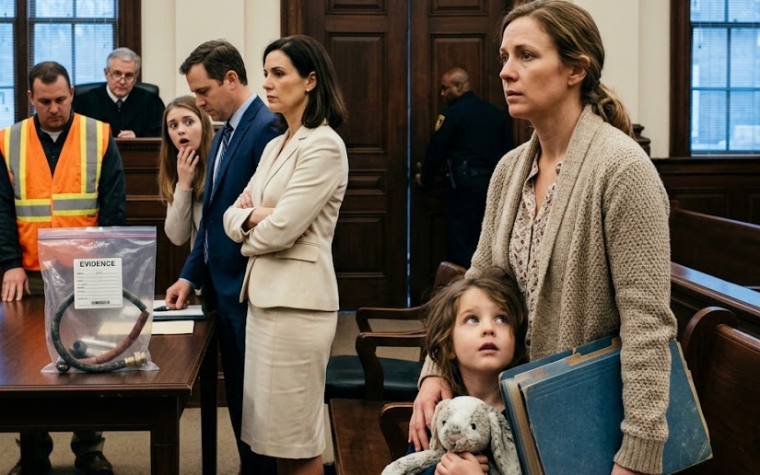
Because Emily handled the household bills, she knew exactly where their financial records were kept.
With legal guidance, she gathered copies of bank statements, insurance documents, rent payments, tax records, and the messages in which Brent ordered her to transfer money or account for small purchases.
The papers did not reveal a secret fortune or a dramatic hidden deed.
They revealed something more believable and, in its own way, more devastating.
Emily was not the irresponsible child Brent had described at dinner.
She had been holding their life together while he told everyone she was incapable of functioning without him.
At the temporary protection-order hearing, Brent arrived in a navy suit with Diane beside him.
He looked polished, rested, and offended.
Emily wore a simple gray dress.
Her hair was tied loosely because her scalp was still tender.
Before the hearing began, Brent tried to catch her eye from across the corridor.
When she refused to look at him, he smiled as though her fear still belonged to him.
Inside the courtroom, his attorney called the restaurant incident a brief misunderstanding magnified by an overprotective mother.
Brent testified that he had touched Emily’s hair only to stop her from causing a scene.
Diane testified that she had never encouraged violence.
Then the restaurant recording played.
There was no sound, but no sound was necessary.
The screen showed Emily speaking with her hands close to her body.
It showed Brent turning.
It showed his fist closing in her hair.
It showed her head jerk backward.
It showed Diane smiling.
Then it showed her clapping.
The young waiter testified next.
He repeated Brent’s warning and Diane’s exact words.
The couple from the window gave the same account.
The emergency call recording captured my description of the assault while the restaurant was still in chaos.
In the background, Brent could be heard saying I would not dare call.
His own voice placed him at the center of the scene he claimed had been misunderstood.
When Emily testified, she did not look at him.
She described the blocked doors, the confiscated phone, the punched walls, and the endless insistence that she could not trust her own memory.
Brent shook his head throughout her testimony.
Diane whispered angrily to his attorney.
Then Emily said, “The first time he hurt me in front of other people was the first time I saw that strangers were more willing to defend me than I was willing to defend myself.”
The judge granted the protection order.
Outside the courtroom, Diane finally lost the composure she had worn like jewelry.
“You have poisoned her against us,” she told me.
Emily stepped between us.
“My mother did not poison me.”
Diane stared at her.
Emily’s voice trembled, but she continued.
“She called for help when your son was hurting me.
You applauded him.”
For once, Diane had no answer that could survive being spoken aloud.
The criminal case did not end with a dramatic trial.
Faced with video, independent witnesses, photographs, and his recorded attempts to pressure Emily afterward, Brent accepted a plea agreement on an assault-related charge.
He received probation, mandatory intervention counseling, and strict no-contact conditions.
He told people the system had been unfair to him.
Diane told relatives Emily had destroyed the family over one bad moment.
But one bad moment had not destroyed their family.
It had revealed it.
The divorce took months.
Brent threatened to leave Emily with nothing, but financial records showed her contributions clearly.
His claims that she was incapable of managing money collapsed under the weight of years of bills paid on time in her name.
Whenever he tried to rewrite their marriage, there was another document, another message, or another witness.
Emily did not win every argument or leave every hearing feeling strong.