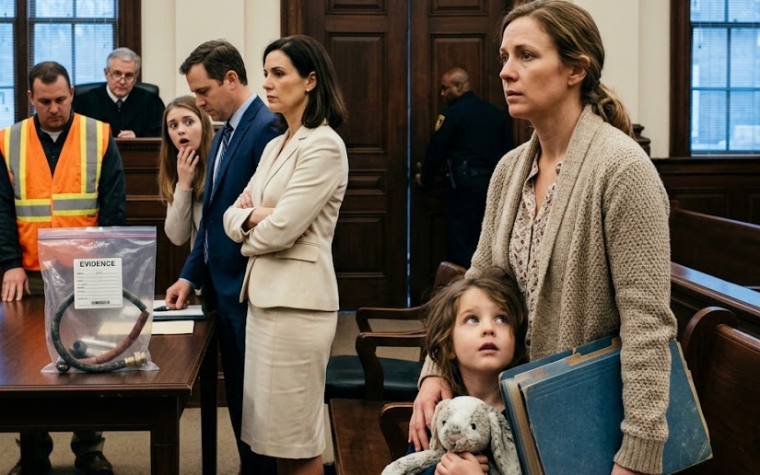
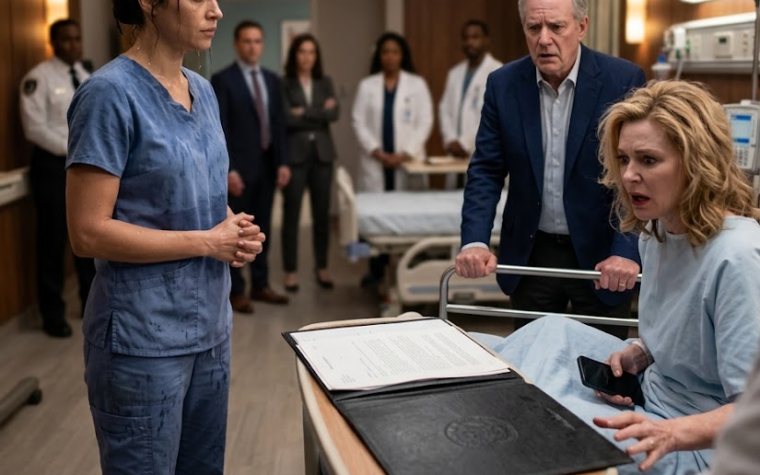
University security arrived first, not to arrest Linda, but to prevent her from leaving with the documents or approaching Natalie.
Linda’s composure finally cracked.
She accused Natalie of ingratitude.
She blamed Richard’s neglect, Mark’s ambition and Caroline’s trust.
She insisted the company would have collapsed if Natalie had exposed the false vendors during Richard’s illness.
Every defense revealed another piece of what she had done.
She admitted using Mark’s credentials.
She admitted intercepting the rehabilitation clinic’s calls.
She admitted arranging a ceremonial funeral without remains, telling the funeral director that the body had been retained by authorities because of the crash investigation.
She had not caused the accident.
She had simply recognized an opportunity inside the confusion and built a lie large enough to control everyone around her.
Mark sat down heavily.
“You made me part of it.”
“I made you successful,” Linda snapped.
“You made me useful.”
In the weeks that followed, the legal structure Linda had built began to collapse.
A court suspended her control over the household trust.
The false death declaration was voided after medical records, fingerprints and a supervised DNA test confirmed Natalie’s identity.
Caroline’s voting shares returned to Natalie, together with the rights that had been taken through the coerced power of attorney.
The company’s independent audit uncovered years of unauthorized transfers.
Some money had funded business expenses, but substantial amounts had moved into accounts controlled by Linda.
Criminal charges followed for fraud, falsification of records, coercion and financial crimes.
Linda denied intending permanent harm, but the recordings, clinic instructions and forged documents showed planning that had continued for two years.
Mark was removed as CFO.
Investigators found no evidence that he knew Natalie was alive, but they concluded that his negligence had allowed the vendor scheme to continue.
He surrendered his corporate authority and cooperated with the investigation.
The career Linda had manufactured for him disappeared almost as quickly as Natalie’s legal death.
Richard also stepped down from daily control of the company.
He refused to pretend he was blameless.
His obsession with work had created the distance Linda exploited.
He had allowed her to handle Natalie’s identification, medical information and funeral because grief made obedience easier than asking questions.
He had signed documents without reading them and accepted a closed casket because Linda told him looking inside would destroy him.
Natalie listened when he confessed these failures, but she did not immediately forgive him.
“She lied to both of us,” Richard said during one of their first meetings after graduation.
“But she used truths I gave her.
I was absent.
You expected me to be late because I usually was.”
Natalie turned the moon charm between her fingers.
“I needed you before the accident.
Not only after you thought I was dead.”
“I know.”
“Knowing isn’t the same as changing.”
“Then I’ll show you.”
He did not ask her to return to Beverly Hills.
He did not offer money or a position in the company.
He attended the medical appointments she invited him to and stayed away from the ones she wanted to face alone.
He arrived early for every meeting.
Sometimes Natalie spoke for an hour.
Sometimes she barely spoke at all.
Richard learned not to fill silence with promises.
Months later, Natalie entered Caroline’s trust office as its restored beneficiary.
Her first decision was to order permanent independent oversight of the family company.
Her second was to establish legal support for patients whose identities or finances had been controlled during medical incapacity.
She did not do it to become a symbol.
She did it because she understood how easily a frightened person could be erased by someone carrying the right papers.
On the first anniversary of her graduation, Richard asked whether she wanted the memorial plaque removed from the church.