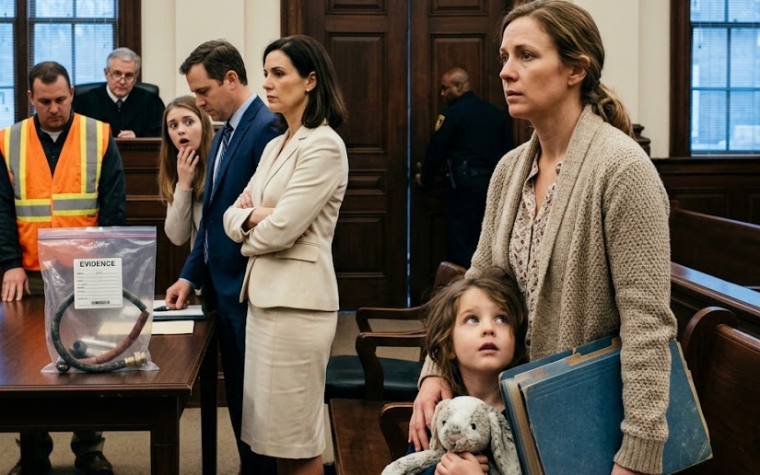
“Then why did he leave us nothing?”
The lawyer corrected her.
Bradley had not left them nothing.
His will included several personal gifts: the carved wooden box for Declan, a collection of family photographs for Fiona, and his father’s watch for Marjorie.
He had also directed that a modest family debt be forgiven.
But the gifts were conditional upon the recipients making no unauthorized claim against me, the apartment or Bradley’s company.
Their actions had placed those gifts in jeopardy.
Marjorie looked toward the wooden box inside the open suitcase.
She had tried to steal the very thing Bradley intended to give them properly.
The lawyer told her that the estate would decide what happened next after reviewing the police report.
She left without another word.
The civil consequences unfolded over the following weeks.
The court issued an order barring Marjorie, Declan and Fiona from entering my home, contacting building staff for access or interfering with Bradley’s business records.
Every copied key was surrendered.
The company obtained a separate protective order covering the drives and photographed notebook pages.
Declan’s claim that he had misunderstood the document case collapsed under the security footage.
He ultimately entered an agreement requiring him to return all copied material, submit his devices for a limited forensic review and pay a portion of the legal and security costs.
The criminal investigation remained open until that review confirmed that no confidential files had been distributed.
Fiona deleted nothing successfully.
The forensic report documented what she had photographed and when.
She signed a binding agreement prohibiting her from using or sharing the information and paid for the review of her phone.
Marjorie contested nothing.
The lawyer’s mention of Bradley’s recorded statement had done what threats could not.
She knew that a public challenge would bring every demand, unpaid loan and manipulative message into the court record.
The rest of the family stopped calling me unstable once they learned there were cameras.
Some apologized.
Most said they had only followed Marjorie because she insisted the estate documents authorized her to take control.
I believed some of them.
I did not invite any of them back.
Weeks later, Bradley’s lawyer returned to the apartment carrying one final envelope.
The rooms had been restored.
The maritime map was back on the office wall.
The brass lamp stood beside Bradley’s chair.
Our anniversary photograph was upright again.
I had not opened the wooden box.
It remained sealed in the estate inventory while the lawyer determined whether Declan had forfeited the gift.
The envelope bore my name in Bradley’s handwriting.
Inside was a single page.
He wrote that he knew his family might confuse his death with an opportunity.
He hoped he was wrong, but he did not want hope to become my burden.
He explained why he had transferred the apartment to me.
It was not because he expected to die.
It was because he wanted the law to reflect what had already been true in his life.
The apartment had been property when he bought it.
It became a home when I entered it.
At the bottom, he had written, “Do not let anyone make you audition for a place I already chose to give you.”
I sat at his desk with the letter in my hands.
For the first time since the funeral, I cried without anyone watching, advising or measuring my grief.
Then I placed the letter beneath the little brass sailboat paperweight I had given him after our first vacation.
Bradley was gone.
Nothing in the deed, the will or the locked office could change that.
But his family had come into my home believing his silence meant there would be no resistance.
They had never understood him.
Bradley’s quiet was not weakness.
It was where he kept the truth until the moment it was needed.