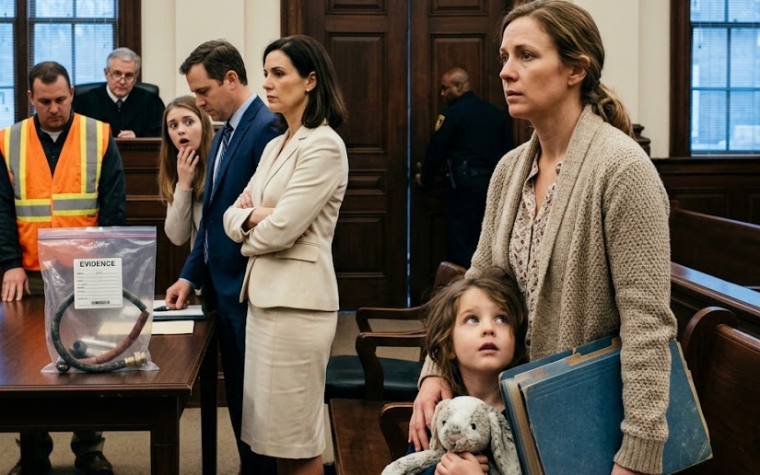
The disputed authorization appeared during that period.
Then, as closing approached and additional valid signatures were still required, they ran out of time.
That was the reason for the garage.
The folding table.
The pen.
The sixty-thousand-dollar threat.
It had never been a family discussion.
It was an attempt to force reality to catch up with paperwork that had already crossed a line.
Chloe finally asked to speak to me through our mother.
I refused.
Then she sent a message through an attorney.
She claimed she had never intended for me to be hurt.
She said Trent had “lost control.” She said the mortgage situation had become desperate and she had made “mistakes” while believing I would ultimately help her.
There was no direct admission in the message.
But there was something I noticed immediately.
She no longer claimed I had agreed to cosign.
That lie had disappeared.
My father noticed too.
“She’s changing the story because the old one can’t survive the evidence,” he said.
He had his own injuries from being shoved into the workbench, though nothing as severe as mine.
His statement became important because he had seen Trent close the garage door, destroy my phone, strike me, wrench my arm, and push the pen toward me.
My mother’s statement mattered for a different reason.
She admitted Chloe had arranged the gathering and had told her I needed to be persuaded before the next morning’s closing.
My mother hated saying it.
She cried through most of the interview.
But for once, she did not soften the truth to protect Chloe.
The house purchase collapsed.
Without a legitimate cosigner and with the loan under scrutiny, there was no closing the next morning.
The deadline passed.
The sixty-thousand-dollar deposit they had used as a weapon against me became their problem, exactly as I had warned them it would.
Whether they had convinced themselves the money entitled them to my credit no longer mattered.
It never had.
Trent faced the immediate consequences of the violence.
The physical evidence, hospital records, my father’s testimony, my destroyed phone, and the condition of the garage supported the account of what happened.
Chloe faced scrutiny over the forged mortgage authorization and her role in bringing me to the garage under false pretenses.
The process moved more slowly than television makes these things look.
There were interviews, lawyers, document requests, hearings, delays, and arguments over who knew what and when.
Trent tried to minimize everything.
He described the confrontation as a “family dispute.”
He suggested I had fallen during an argument.
That explanation did not fit a dislocated shoulder, facial injuries, a smashed phone, my father’s statement, or the medical findings.
Then he shifted blame toward Chloe.
She had planned the meeting, he said.
She had told him I had already agreed.
She had been the one panicking about the deposit.
Chloe responded by blaming him.
He was controlling, she said.
He had become obsessed with getting the house.
He was the one who closed the garage door.
He was the one who hit me.
Watching them turn on each other was not satisfying in the way I might once have imagined.
It was ugly.
They had been perfectly united when the person absorbing the damage was me.
The unity disappeared only when consequences reached them.
The most difficult conversation happened with my mother.
She came to my apartment several weeks after I left the hospital.