The judge read the first paragraph twice.
Nobody spoke.
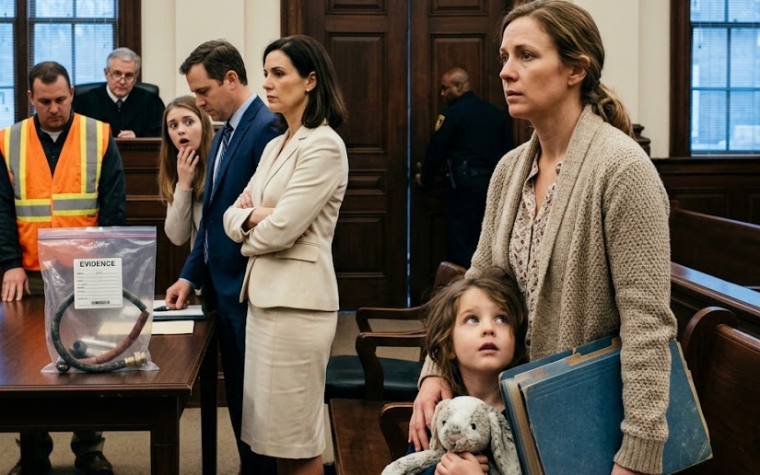
The same courtroom that had been filled minutes earlier with Julian’s confidence now seemed to have contracted around a weathered red folder.
Julian stared at it from across the aisle.
Nora stared harder.
That was when I knew she recognized it.
Marcus Hale remained beside the evidence table.
“Your Honor,” he said, “the document before you is an original capitalization and ownership agreement executed during the formation of Vance Medical Technologies.
Attached to it is the corresponding ownership schedule and intellectual-property assignment.”
Julian’s attorney stood immediately.
“We have never seen this document.”
Marcus looked at him.
“That appears to be part of the problem.”
The judge raised one hand before either man could continue.
“Sit down.
Both of you.”
They did.
I remained standing beside Marcus.
Years earlier, before Vance Medical Technologies had offices, investors or a marble lobby, it had been little more than a medical technology project, a stack of research notes and an idea I refused to abandon.
Julian had been charming then.
Ambitious.
Fearless in rooms where I preferred to work quietly.
I understood the technology.
He understood how to sell a vision.
For a while, that combination worked.
During the company’s formation, our attorneys created documents separating public-facing management from the underlying ownership rights connected to the technology and initial capitalization.
Julian became the visible executive.
His surname became the brand.
But the original ownership schedule recorded something that later corporate summaries gradually stopped mentioning.
My controlling interest had never been transferred to him.
Julian had authority to manage significant company operations.
He did not have authority to quietly convert my ownership into his own.
The judge looked up.
“Mrs.
Vance, where has this original been kept?”
“For years, in our private corporate archive,” I said.
“When I discovered files had been altered, I removed it.”
Julian finally found his voice.
“That’s absurd.”
The judge turned toward him.
“Which part?”
“The whole thing.
It’s ancient paperwork.
The company changed.
There were restructurings.
New shares.
New agreements.”
Marcus nodded.
“There were.
We have those too.”
For the first time, Julian looked at Marcus rather than me.
Marcus opened another folder.
This one was newer.
Inside were copies of board records, electronic transfer logs and archived corporate files.
Some had been recovered from backups after their active versions were deleted.
Others came from third-party custodians who retained records independently of Julian’s office.