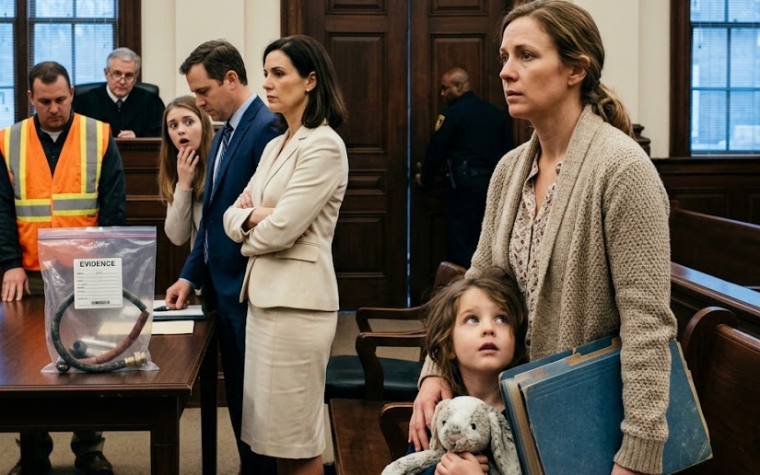
Julian told me everything was approved.
Marcus wrote the sentence on his legal pad.
Julian saw him do it.
His face changed again.
For two years, Julian and Nora had behaved as though secrecy itself created ownership.
If a transfer was hidden long enough, if a document disappeared, if an account was moved, if an old record stopped appearing in new summaries, then eventually everyone would accept the new reality.
They had mistaken concealment for legitimacy.
Marcus moved to the next issue.
The mansion.
Julian had bragged that morning that it belonged exclusively to him because the recorded ownership documents carried his name.
But its purchase had been financed largely through a company distribution tied to the ownership structure contained in the red folder.
More importantly, internal correspondence showed Julian discussing the house as an asset he could “park” temporarily while a broader restructuring was underway.
That phrase came from his own email.
Park it.
The cars followed a similar trail.
Several had been purchased using money routed from accounts now under dispute.
Nothing automatically meant the judge would simply hand every object to me.
Divorce law and corporate law were more complicated than Julian’s courtroom boasting.
But his claim that everything unquestionably belonged to him had collapsed in less than an hour.
Then Marcus produced the hidden corporate files.
These mattered because they showed intent.
One directory contained draft versions of ownership schedules.
In early versions, my interest appeared exactly as it had for years.
In later drafts, my name disappeared.
There was no corresponding signed transfer.
No purchase agreement.
No properly executed surrender of shares.
My name had simply been removed from a working document.
Metadata connected the edits to accounts controlled by Julian’s executive office.
Another series of files contained communications about moving liquid assets before the divorce became “messy.”
Julian argued that the wording referred to ordinary financial planning.
Then Marcus displayed the dates.
The largest transfers began days after Julian learned I had consulted a divorce attorney.
The courtroom remained quiet.
I watched Julian rather than the documents.
His jaw was tight now.
The relaxed posture was gone.
He kept whispering to his lawyer, who had stopped answering him every time.
Nora looked as though she wanted to disappear.
The judge called a recess.
Outside the courtroom, reporters crowded the hallway, but Marcus guided me into a small conference room.
I finally exhaled.
“How bad is it for him?” I asked.
Marcus closed the door.
“The ownership issue is strong.
The transfer evidence is serious.
But don’t celebrate yet.
He will attack the document.”
He was right.
When the hearing resumed, Julian’s attorney argued that the red-folder agreement had been superseded.
He questioned whether the ownership schedule remained legally effective.
He suggested that later corporate actions diluted or modified my position.
Marcus had expected every argument.
For each one, he had a later document referencing the earlier agreement.
A lender’s due-diligence file described me as a continuing beneficial owner.
An insurance disclosure identified my retained interest.