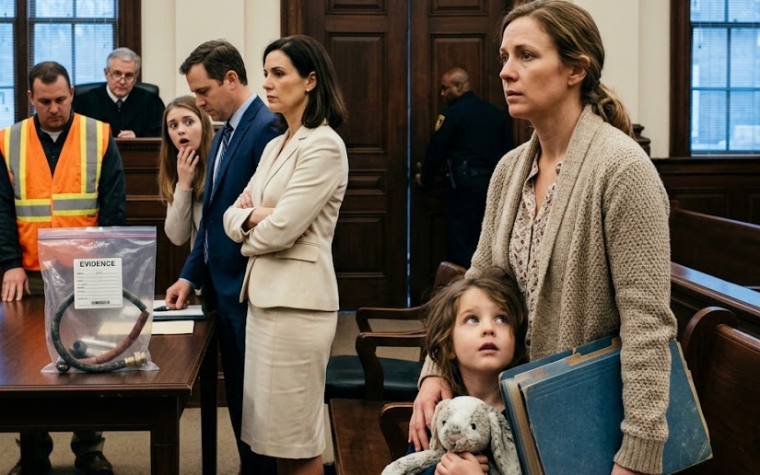
I stopped several feet away.
“You lied to the police.”
“We did not lie,” Ryan said.
“We thought you’d come.”
“I told you I would not.”
“You always say that when you’re angry.”
“And you always ignore me because everyone lets you.”
Madison pointed toward the interview rooms.
“Now there’s an investigation because you wanted to prove a point.”
Officer Daniels appeared behind me.
“The investigation exists because four children were left without an adult,” he said.
Madison’s hand dropped.
Ryan tried a different approach.
His voice softened, and he gave me the wounded expression he had used since we were children whenever he wanted our parents to choose his side.
“Liv, they’re your nieces and nephews.”
“Yes.”
“They could be taken away from us.”
“Then you should not have left them alone.”
“We had an appointment.”
“You had four children.”
His face hardened.
“You’re enjoying this.”
I almost laughed, not because anything was funny, but because he still needed me to be the villain.
Without that story, he would have to look directly at what he had done.
“I am not enjoying any of this,” I said.
“I am simply not carrying it for you anymore.”
Madison stepped closer.
“I’m pregnant.
Do you understand what stress can do?”
“I understand that pregnancy does not erase a read receipt.”
Officer Daniels asked them to return to their seats.
I walked out of the station without looking back.
The next weeks were uncomfortable for everyone except, strangely, me.
Mom and Dad suddenly had the responsibility they had assigned to me so casually.
School drop-offs began before sunrise.
One child needed help with reading, another refused to sleep without a night-light, and the youngest woke twice most nights asking for Madison.
Mom called me on the third evening.
I answered because I wanted to know whether the children were all right.
“They miss their parents,” she said.
“And they keep asking when you’re coming.”
“I’ll visit Saturday for two hours.”
“Could you stay overnight? Your father and I are exhausted.”
There it was again—the old opening, the familiar expectation waiting behind a softer voice.
“No.”
Mom was quiet.
Then she said, “All right.”
It was the first boundary she accepted without argument.
On Saturday, I brought board games and spent the afternoon with the children.
I did not question them about that morning.
I did not criticize their parents in front of them.
When the oldest quietly asked whether the police came because he had done something wrong, I knelt beside him.
“You did exactly the right thing by calling Grandma,” I said.
“Adults are responsible for making sure children are safe.
None of this was your fault.”
His shoulders loosened.
Before I left, Mom followed me to the porch.