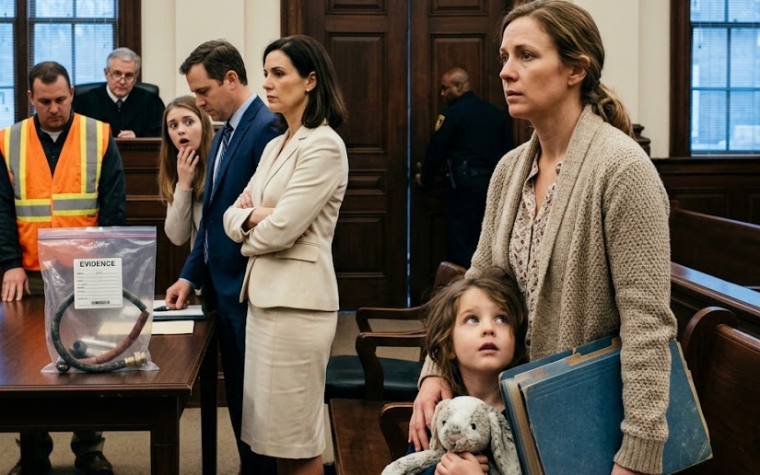
But instead of stopping, he said, “This is exactly what I’ve been trying to explain.”
That was the moment he lost more than his argument.
He exposed the instinct underneath it.
When he believed Avery supported him, she was a child whose experiences deserved protection.
The moment her evidence contradicted him, she became someone whose judgment could be attacked.
The judge ordered him to stop speaking.
Then she called another recess.
This one lasted longer.
When we returned, the atmosphere had changed completely.
Daniel no longer sat with one ankle crossed over the other.
Both feet were flat on the floor.
His hands were clasped tightly enough that his knuckles showed white.
The judge began carefully.
She said custody decisions were not rewards for good spouses or punishments for bad ones.
They were based on the child’s best interests.
She also emphasized that one recording did not decide every disputed fact in a marriage.
For a few seconds Daniel seemed to breathe again.
Then she continued.
What concerned the court, she said, was the evidence that Avery had been placed in the middle of the parents’ dispute, questioned repeatedly about incidents later used in litigation, instructed not to disclose conversations to her mother, and pressured—whether deliberately or not—to adopt an adult’s interpretation of events.
The court would not grant Daniel’s request for sole custody.
My lungs finally released a breath I hadn’t realized I was holding.
But the judge wasn’t finished.
She ordered that the existing arrangement remain temporarily in place while a neutral custody evaluator and child advocate completed a fuller review.
Neither parent was to discuss testimony, filings, or strategy with Avery.
Exchanges would be structured to minimize conflict.
Both of us were ordered to follow the evaluator’s recommendations, and Daniel was specifically warned that further attempts to influence Avery’s account could affect future parenting-time decisions.
It wasn’t the theatrical punishment people imagine happens in court.
No one dragged him away.
No gavel came crashing down.
There was no victory music.
Real consequences were quieter.
His sole-custody petition—the weapon he had walked in believing was already sharpened—had failed.
His credibility was damaged.
His conversations with Avery were now part of the official record.
And for the first time, someone with authority had told him that calling his control “protection” did not automatically make it so.
Daniel stared straight ahead while the judge finished.
Avery began crying silently beside me.
Only after the hearing was formally adjourned did I turn to her.
She whispered, “Are you mad?”
The question nearly broke me.
“For what?”
“For recording Dad.
For not telling you.”
I crouched so we were eye to eye.
“No.”
“But I kept it secret.”
“You were trying to figure out what to do.”
She nodded.
“I thought if I told you, you’d fight with him, and then he’d say it was because you were emotional.”
There was Daniel’s label again, living inside our daughter’s head.
I wanted to tell her everything I thought about that.
Instead I said, “You do not have to manage our feelings.
Mine or Dad’s.”
She looked toward the courtroom doors.
“I didn’t want him to lose me.”
“You aren’t something either of us gets to win.”